
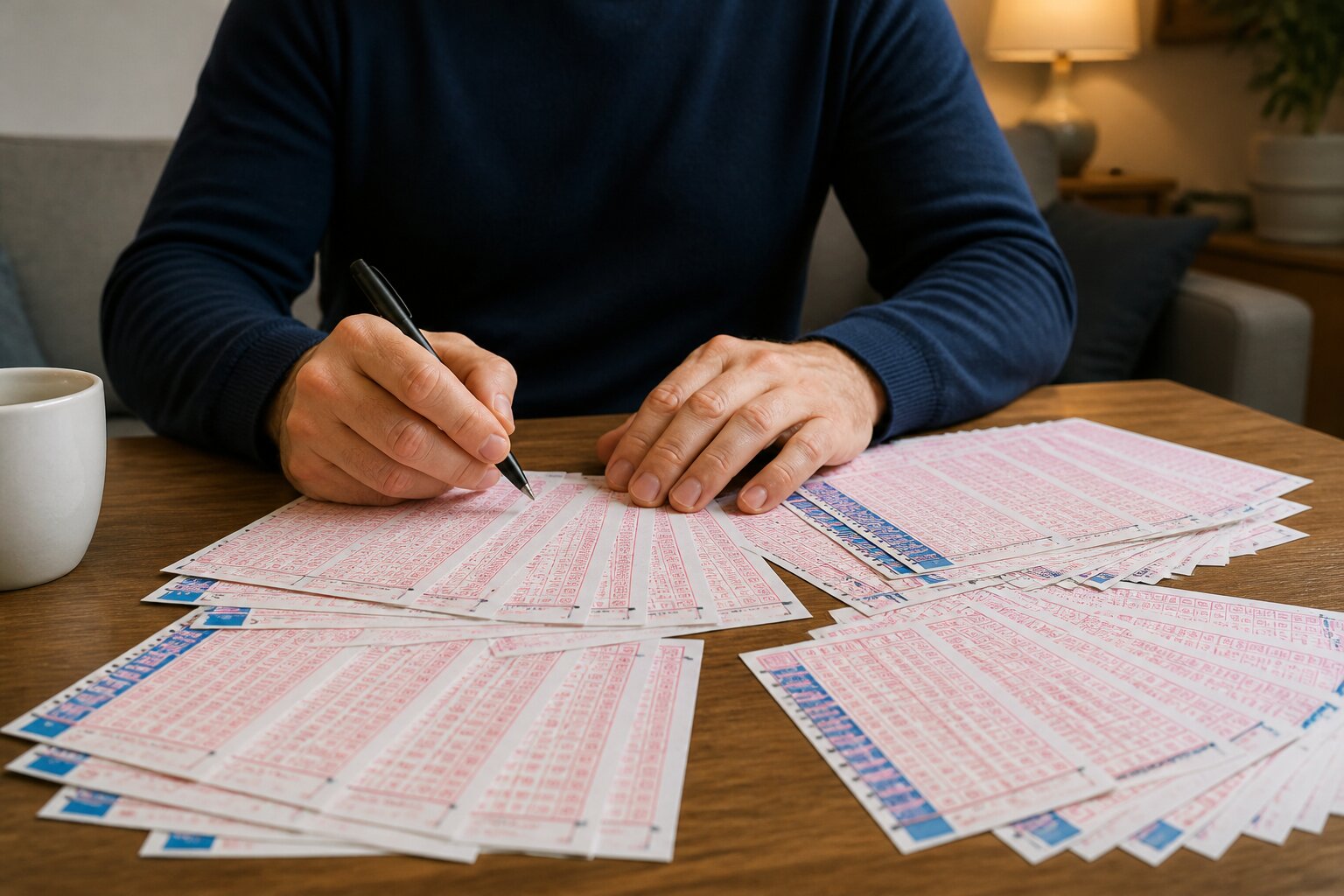
Ever wondered what would happen if you buy a ticket for every possible lottery combination? The idea feels straightforward: cover every outcome, guarantee a win and walk away with the jackpot. While tempting to imagine, the reality is far more complex once cost, logistics and the maths are included.
This piece explores what “buying every combination” actually means, how many tickets it would take for common UK games, and why the plan usually collapses under practical and financial pressures. Read on for clear examples and the key reasons this approach rarely makes sense.
What Does Buying All Lottery Combinations Mean?
Buying every combination means purchasing one ticket for every unique set of numbers that could be drawn in a given lottery. If it were possible to acquire each of those tickets before the draw, at least one would match the winning numbers for that draw.
Using the UK Lotto as an example: players choose 6 numbers from 1 to 59. To cover every possibility you would need one ticket for each unique six-number set, which is a very large number. That size is important, because it drives the cost and the practical difficulties—both of which make the idea much harder to carry out than it sounds. The next section explains how to calculate that number precisely.
How Many Combinations Are There in a Lottery Draw?
The number of possible combinations depends on the count of selectable numbers and how many you pick. This is calculated with combinations (n choose k), which counts ways to choose items where order does not matter. The formula gives a precise count of distinct sets you could select, and it does not consider the order in which numbers are drawn.
For UK Lotto:
- n = 59 (numbers to choose from)
- k = 6 (numbers chosen per ticket)
- Formula: number of combinations = 59! / (6! × (59 – 6)!)
For Lotto that yields 45,057,474 unique combinations. Each single ticket corresponds to one of those combinations and carries the same chance as any other. Because the number is so large, the probability of any one ticket matching all six drawn numbers is 1 in 45,057,474, which demonstrates how long the odds are in a single play.
With that scale in mind, the cost implications become clear, which the following section lays out step by step. Buying many tickets still only buys you more entries and does not change the underlying odds for each combination, so players should consider both the financial cost and the low probability of winning.
Step-by-Step: How Buying Every Combination Works
First, calculate how many unique tickets are needed. For UK Lotto that’s 45,057,474 lines. Multiply that by the ticket price to get the total outlay—for Lotto at £2 per ticket, the sum reaches tens of millions.
Next comes generation and purchase. Producing every unique ticket requires software or systems geared to create exhaustive combinations; retail channels and typical online accounts cannot handle purchases at that scale. Lottery operators also set per-account and per-draw limits and can refuse unusually large transactions.
After purchase, managing the tickets becomes a major task: safekeeping, tracking which ticket corresponds to which numbers and confirming results after the draw. Even if one ticket matches the main numbers, prizes may be shared with other winners and lower-tier payouts can be fixed amounts that do not offset the huge initial cost.
These logistical and financial realities show why the theoretical guarantee of a win rarely equals a practical or profitable outcome. For a concrete sense of scale, the next section gives simple examples using real game formats.
Simple Examples of Buying All Lottery Tickets
Consider UK Lotto: 45,057,474 combinations at £2 each equals £90,114,948 for one draw. If the jackpot were £8 million and you were the sole winner, that prize would be far smaller than the cost to buy every ticket, so the net result would be a very large loss.
EuroMillions is even larger: the game uses a 5+2 format (5 from 50 plus 2 Lucky Stars from 12), producing 139,838,160 combinations. At £2.50 per ticket, covering every line would cost about £350 million. Even a multi-hundred-million-pound jackpot would not cover that outlay, and the practical impossibility of buying and storing so many tickets adds to the problem.
These examples illustrate the fundamental mismatch between ticket cost and potential return: the mathematics are straightforward, and they make clear the scale of the obstacle.
Potential Costs & Practical Limitations
The primary barrier is financial. Millions of unique combinations multiply quickly into sums that are typically out of reach. Beyond money, there are operational barriers: printing, storing and verifying millions of tickets would require a dedicated team and specialist systems.
Retail and online limits stop most large purchases, and lottery operators monitor for suspicious activity that could affect fairness. Time constraints are also critical: submitting millions of entries before a draw closes is usually impossible through normal channels.
Taken together, these factors create a tight practical ceiling on attempts to buy every combination. The next section considers the legal and regulatory perspective you would encounter if someone tried.
Is It Legal to Buy Every Lottery Combination?
There is no general criminal prohibition on buying multiple lottery tickets, but operators impose limits and terms to protect the integrity of a game. Accounts and retail purchases are subject to caps; operators may refuse service if a request appears to be an attempt to dominate a draw or circumvent rules.
Regulators require operators to watch for unusual patterns and to act where activity could undermine fairness. Attempting to acquire every combination would almost certainly trigger those safeguards and could lead to refused transactions or further investigation. Understanding the operator’s terms and the regulatory environment is therefore essential before attempting any large-scale purchase.
What Are the Real Chances of Winning Everything?
Owning all possible tickets for a single draw would guarantee that one of those tickets matches the drawn numbers, so in that narrow sense the chance of “missing” the winning combination is nil. But guaranteeing the winning numbers does not guarantee a profit.
If other players also hold winning tickets, the jackpot is shared and any individual return drops. Many lower-tier prizes are fixed and will not scale to cover the extraordinary purchase cost. The mathematics show that the expected return, after accounting for prize-sharing and the fixed structure of smaller payouts, typically leaves a substantial deficit relative to the total spent.
With that financial reality is a reminder: lotteries are structured so that the average return is less than the amount staked, and holding every combination does not alter that broader design. The following section pulls these threads together.
The Bottom Line: Why Buying Every Lottery Ticket Isn't Practical
Buying every lottery combination looks like a simple shortcut, but it collides with three hard truths: prohibitive cost, severe practical and operational barriers, and regulatory limits that preserve fairness. Even when considering the chance of winning a jackpot, splitting prizes and the fixed nature of smaller awards mean that the total return rarely approaches the amount spent.
For most people, and even for large groups, this approach is neither feasible nor economically sensible. Treating lottery play as entertainment and staying within personal limits keeps the experience manageable and fair. If you’re exploring lottery options on this site, consider the comparisons and details we provide to make informed choices that suit your budget and interests.
**The information provided in this blog is intended for educational purposes and should not be construed as betting advice or a guarantee of success. Always gamble responsibly.