
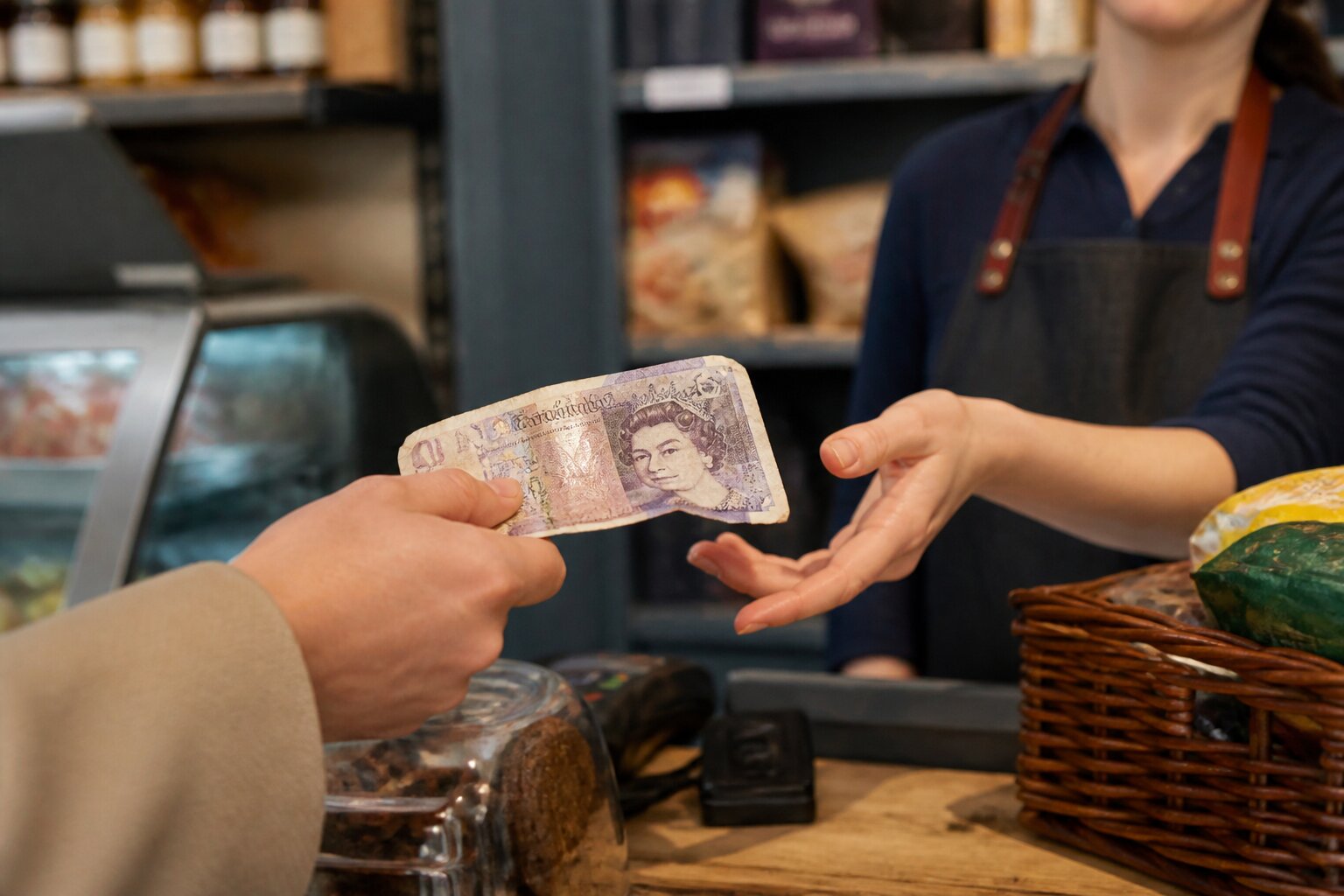
Ever pulled a crumpled tenner from your pocket and wondered if the shop will actually take it? You’re not alone—damaged notes turn up everywhere, whether it’s a slight tear, a corner missing, or a well-worn fiver hanging on for dear life.
Before you try to spend that battered banknote, it helps to know what counts as damaged, what shops will accept, and what your options are if a retailer refuses it. A little context can save you time at the till and the bother of being left with unusable cash.
Curious about how stores and banks deal with ripped notes and what to do next? Read on to get a clear picture of the rules and practical next steps.
What Counts as a Damaged Banknote?
A damaged or defaced banknote is any note that can’t be used in the usual way because it’s torn, incomplete, stained, or altered. The Bank of England sets out standards that help banks and retailers decide whether a note is acceptable.
Common examples of damaged notes include torn or ripped notes (even if partly), notes with pieces missing, banknotes with writing or stains, those that have been washed or shrunk, notes with holes or burns, and notes that have been repaired with tape or glue. Even minor damage can make a note unacceptable in certain situations, because visible defects can hide important security features.
Retailers and bank staff assess each note on its condition and how much of the original note remains. That assessment determines whether it can be used, exchanged at a branch, or sent for specialist review.
Are Shops Required to Accept Ripped Notes?
Shops in the UK are not legally required to accept damaged or ripped banknotes. Retailers have the discretion to refuse notes that are torn, defaced, or seem hard to verify. This discretion is intended to protect businesses from taking notes that might be unsafe or impossible to validate.
Different shops apply different thresholds: some will accept notes with light damage, while others will refuse anything less than perfect condition. The practical effect is that, at the till, acceptance comes down to judgment by the retailer or the capabilities of their till equipment.
Knowing this makes it easier to understand why staff sometimes decline damaged cash: they are following store policy and protecting both themselves and customers from complications.
What Should You Do If a Shop Refuses a Damaged Note?
If a shop declines a note, it helps to stay calm and polite. Staff are generally acting to keep transactions clear and secure, not to embarrass anyone. When refusal happens, the most common outcome is using a different payment method or asking whether a bank or Post Office nearby can help.
If you leave the shop with the note, bank branches and some Post Office counters will usually assess it and explain the next options. That assessment may lead to an immediate exchange or to a referral for further review, depending on how much of the note remains and how damaged it is.
Being prepared for this sort of situation makes it less stressful: keeping an alternative payment method handy or knowing where your closest bank branch is can make the experience straightforward.
How to Exchange Damaged Banknotes in the UK
Exchanging a damaged note is generally handled by banks, building societies or, in some branches, Post Offices. The usual approach is to examine the note to see how much of it remains and whether security features are still visible; if sufficient of the note is present and it is not grossly defaced, a replacement is often issued at branch level.
Where a note is partially missing, badly mutilated, or part of a larger amount, the bank may advise sending the fragments to an official body for a detailed assessment. This is a standard process for particularly degraded notes and usually involves some paperwork and a short waiting period while the claim is considered.
Not every damaged note is automatically replaced: each case is judged on its own merits and the guidance set out by the relevant authorities.
Can You Use Damaged Notes at Self-Checkouts?
Self-checkout machines rely on optical and mechanical checks to verify banknotes, so they tend to accept only notes that are in good condition. When a note is torn, heavily creased, marked or otherwise damaged, these machines may reject it because key security features cannot be read reliably.
The machine’s rejection is automatic and cannot be overridden, which can be frustrating at busy tills. In those moments it is useful to know that staff usually cannot force the machine to accept a note, and that the best course is to use another payment method or have the note assessed later at a bank.
This reflects how technology prioritises verification: if a machine cannot confirm a note’s features, it will err on the side of refusal.
Common Myths About Damaged Banknotes
Several persistent myths surround damaged notes. One is that shops must accept any cash regardless of condition; in reality acceptance is discretionary. Another is that all damaged notes can be instantly replaced by a bank; while many can be exchanged, some cases require further assessment or may be rejected if too little of the note remains. A further misconception is that self-checkouts behave the same as staffed tills—machines are usually stricter because of how they verify notes.
Separating fact from fiction helps you approach a damaged note calmly and understand the likely outcomes when you try to spend or exchange it.
Tips for Handling and Preventing Damaged Notes
Keeping notes in good condition is straightforward and reduces the chance of problems at the till. Store notes flat rather than folded tightly, and keep wallets or purses dry and clean to avoid shrinkage and staining. Avoid marking or writing on notes and do not use tape or glue to mend tears, as repairs can make a note less acceptable. Handling notes gently, particularly polymer issues which can crease, will help them remain usable for longer.
Try to keep notes away from heat sources, strong sunlight and chemicals such as bleach or solvents, which can discolour or weaken paper and polymer. When washing clothes, check pockets first to avoid accidental damage. If a note becomes wet, lay it flat to dry rather than rubbing or wringing it, and avoid ironing.
Small habits make a big difference:
- Keep notes flat in a wallet or note holder rather than folded tightly in pockets.
- Avoid putting notes next to sharp objects, loose coins or keys that can cause tears or holes.
- Do not staple, tape or write on notes, even lightly, as this can affect acceptability.
- Inspect notes before use and, if in doubt about a note's condition, take it to a bank or Post Office for guidance.
What to Do With Severely Damaged or Unusable Notes?
When a note is badly torn, burned, or missing large sections, it should not be used in shops or inserted into machines. Extremely damaged notes are usually unsuitable for routine transactions and are handled through a formal assessment process instead.
The Bank of England’s guidance explains how severely damaged notes are assessed and when a claim is appropriate. Claims typically involve providing the remaining fragments and a description of how the note was damaged; the official body then examines the material and decides whether a replacement is due. This process can take some time, particularly for notes that require detailed forensic checks.
Sending damaged fragments for assessment is the proper route when a local branch cannot offer a replacement, and it ensures cases are handled consistently and transparently.
Never attempt to use severely damaged notes where verification cannot be made; following the established assessment channels is the safest way to resolve the problem.
This guide should help you spot damaged notes, understand how shops and machines treat them, and know the routes available for exchange or further assessment. If you find yourself with a ripped or defaced note, the options are clear: use an alternative payment method at the till, have the note reviewed at a bank or Post Office, or follow the official assessment route for severely damaged examples.
**The information provided in this blog is intended for educational purposes and should not be construed as betting advice or a guarantee of success. Always gamble responsibly.