
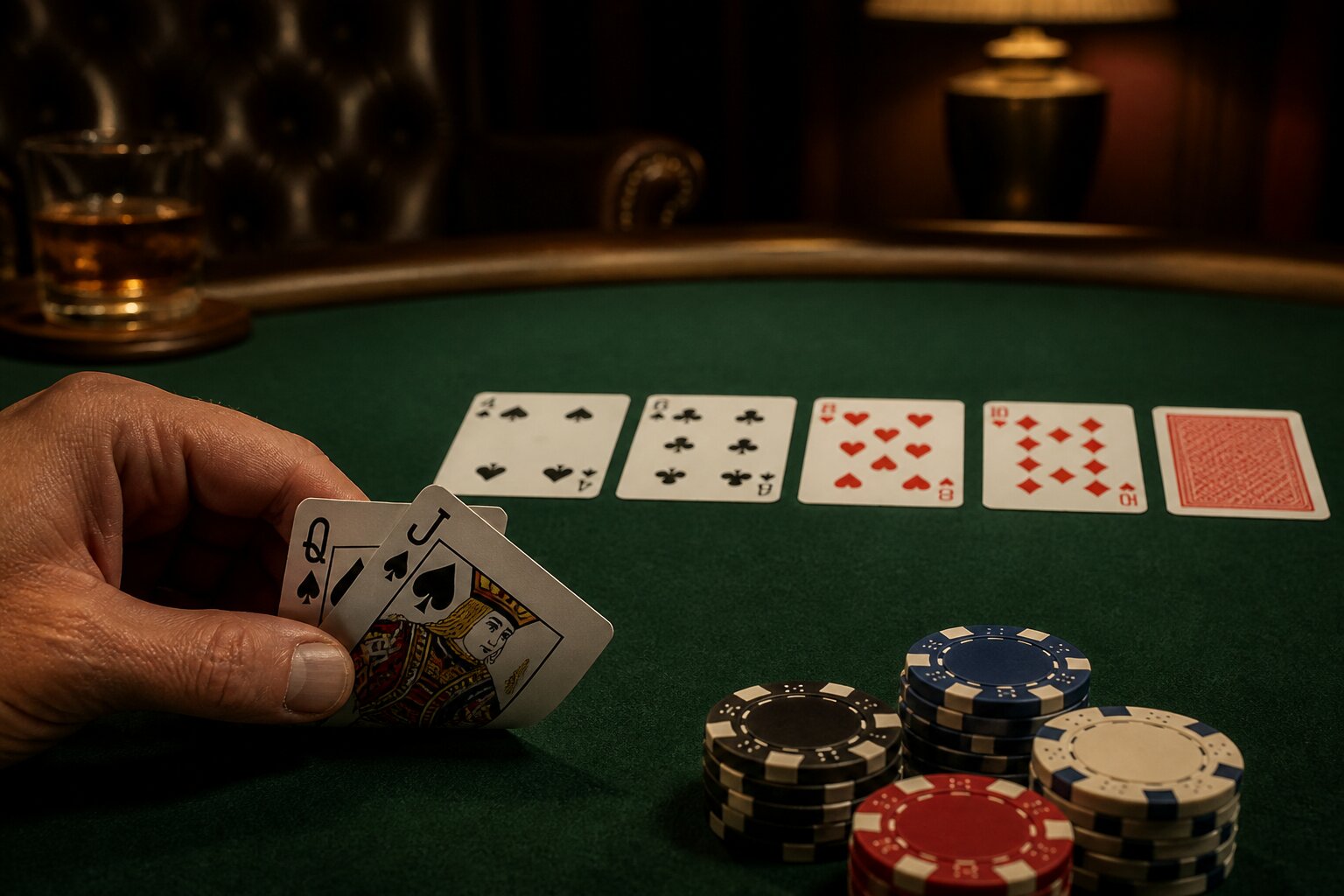
Ever found yourself one card away from a straight, but with just an inside chance of hitting it? That’s the tension of the gutshot straight draw, a hand that can flip the table or leave you wishing you’d folded sooner. Whether you’re at a home game or playing online with friends, recognising this draw and understanding its realities makes a big difference to your decision-making.
Spotting a gutshot after the flop forces a choice: continue for a single specific card, or fold and preserve chips for a clearer opportunity. The sections that follow explain what a gutshot is, how it compares to other straight draws, the odds involved, and how these draws behave across different poker variants.
If you want to decide with more confidence, read on to see examples and practical guidance that help you weigh the risk versus the potential reward.
What Is a Gutshot Straight Draw in Poker?
A gutshot straight draw, sometimes called an inside straight draw, happens when only one specific rank of card will complete your five-card straight, and that missing card sits inside the sequence. Unlike draws that can finish on two different ranks, a gutshot depends on a single rank appearing among the remaining cards.
For instance, imagine you hold 7 and 10, and the flop shows 8 and Jack. Only a 9 will complete the straight sequence 7-8-9-10-J, so you have a gutshot. Another clear example is holding 5 and 8 with a board showing 6 and 7, where only a 9 will make 5-6-7-8-9.
Because there is just one rank that helps you, gutshots are less likely to complete than open-ended draws. That lower probability is the main reason they require careful assessment before committing more chips. The next section compares gutshots and open-ended draws to make that contrast clearer and practical at the table.
How Does a Gutshot Straight Draw Differ from an Open-Ended Straight Draw?
The essential difference is the number of ranks that can complete the straight. A gutshot relies on one missing rank, while an open-ended straight draw has two possible ranks that will do the job.
If you hold 6 and 7 and the board shows 8 and 9, both 5 and 10 would finish your straight, giving you twice the number of outs compared with a gutshot. That extra chance often changes how aggressively players proceed. Open-ended draws are easier to justify calling or raising with, because the probability of success is markedly higher.
Knowing which type you have affects decisions about pot odds and position, as well as whether you can threaten opponents on later streets. With that in mind, the next section gives concrete table examples to help you recognise gutshot situations quickly.
Recognising a Gutshot Straight Draw: Key Examples at the Table
Here are everyday situations where only one rank completes the straight, making the draw a gutshot.
Example 1: You hold 4♦ and 7♠. The flop is 5♣, 6♠, and Q♥. Only an 8 completes the straight 4-5-6-7-8.
Example 2: You have 9♣ and Q♦. The flop shows 8♠, 10♥, and 2♣. Only a Jack gives you 8-9-10-J-Q.
Example 3: Your hand is 3♠ and 6♣, with the board containing 2♥, 4♦, 5♠, and J♠. A single 7 fills the gap to make 3-4-5-6-7.
Example 4: You hold J♥ and A♠. The board after the turn shows 10♦, K♣, and Q♠. Only a King on the river produces 10-J-Q-K-A.
Recognising these patterns quickly lets you estimate outs and plan your actions, whether you’re considering a call, check, or fold. The following section turns those recognitions into numbers by explaining the odds behind gutshot draws.
Calculating the Odds: Gutshot Draws Explained
Gutshot draws have exactly four outs in a standard 52-card deck, assuming none of the helpful rank cards are already visible on the board or in opponents’ folded hands. From the flop, with five known cards (your two plus three on the board), there are 47 unseen cards. The probability of hitting your one required rank on the turn is 4/47, which is about 8.5%.
If the turn does not complete the straight, the chance on the river becomes 4/46, or roughly 8.7%. Taken together from flop to river, your chance of landing the gutshot on either street is just under 17%.
These figures show why gutshots are long shots compared with open-ended draws, which offer around 32% from flop to river. Translating those percentages into pot odds helps decide whether continuing is mathematically sensible. With that framework in mind, the next section outlines the situational factors that influence whether chasing a gutshot is worth the risk.
When Should You Chase a Gutshot Straight Draw?
Deciding to chase a gutshot depends on more than the raw odds; pot size, the bet required to continue, position, stack sizes, and the wider game context all matter.
Pot odds are key. If the pot offers a return that outweighs the cost of a call given your roughly 8.5% chance to hit on the next card, staying in can be justified. For example, calling £5 into a £50 pot often makes sense on mathematical grounds, though reads on opponents and future streets still play a part.
Position matters because acting later gives more information about other players’ hands and intentions, which can influence how much value you can extract if you hit. Stack sizes and whether you are in a tournament or cash game also shift the calculus; tournament decisions sometimes justify riskier plays due to blind pressure, while deep stacks in cash games may favour pot control.
Finally, consider how a completed straight will rank against likely opponent holdings. Hitting an inside straight that still loses to a higher straight or a flush is less valuable. Balance these considerations to make choices that match your risk tolerance and strategy. Next, the article looks at how gutshot draws surface across different poker variants.
Gutshot Draws in Different Poker Variants
Gutshot draws appear in many poker formats, but the way they form and how valuable they are can vary with the rules of each game.
Texas Hold'em: In Hold’em, you combine your two hole cards with the five community cards. A hand like 6♠ and 9♣ with a flop of 7♦, J♠, and 8♥ is a textbook gutshot, since only a 10 can make 6-7-8-9-10. The shared community cards mean opponents often have related draws, so assessing their likely holdings becomes part of the decision.
Omaha: With four hole cards and the requirement to use exactly two of them, Omaha creates more potential combinations but also stricter selection rules. If you hold 5♣, 6♦, 7♠, and Q♠ and the flop is 4♥, 8♥, and K♣, using two of your cards plus three from the board creates a gutshot where only a 9 completes the straight. Pay particular attention to how many of your outs are duplicated by opponents’ holdings in multi-way pots.
Seven Card Stud and other variants: In stud formats, you see a mix of up and down cards, and the larger number of personal cards can both increase and obscure draw possibilities. Gutshots still occur, but they may be harder to spot until later streets.
Understanding variant-specific mechanics helps you judge when a gutshot is worth pursuing. The next section clears up common misconceptions that can cloud good decision-making.
Common Myths About Gutshot Straight Draws
Several persistent misconceptions about gutshot draws can lead to poor choices at the table. Here are four common myths and the realities that correct them.
Myth: Gutshot straight draws hit more often than you think.
Reality: With only four outs, gutshots have low probabilities — about 8.5% on a single card from the flop to turn and just under 17% from flop to river.
Myth: Chasing a gutshot shows superior skill.
Reality: Pursuing a gutshot sometimes fits a broader strategy, but success should be based on maths, position, and context rather than the draw alone.
Myth: A gutshot is often due if it’s missed repeatedly.
Reality: Each card dealt is an independent event; previous misses do not increase the chance of a future hit.
Myth: Gutshots are as good as open-ended straight draws.
Reality: Open-ended draws provide roughly twice the number of outs, making them significantly more reliable.
Clearing up these myths helps keep decisions grounded in facts and judgement, which is especially important when stakes are meaningful. That brings us to practical takeaways so you can apply these ideas at the table.
Practical Takeaways for Playing Gutshot Straight Draws
Recognising a gutshot is the first step. From there, combine the mathematical odds with situational judgment. Estimate pot odds before committing chips, be mindful of position, and consider what your completed hand will beat. When multiple opponents remain, your effective chance of winning after hitting decreases if the board also allows higher straights or flushes.
Keep your bet sizes and calls aligned with the probability of completing the draw and with your overall game plan. Managing bankroll and avoiding risky calls that exceed your limits are sensible habits for any player. If these principles guide your choices, you’ll make more consistent, profitable decisions around gutshots.
Play Casino Games at Slots UK
We invite you to enjoy the relaxed fun of playing casino games with us at Slots UK. Discover the enjoyment of exploring what we have to offer in your own time and at your own pace.
**The information provided in this blog is intended for educational purposes and should not be construed as betting advice or a guarantee of success. Always gamble responsibly.