
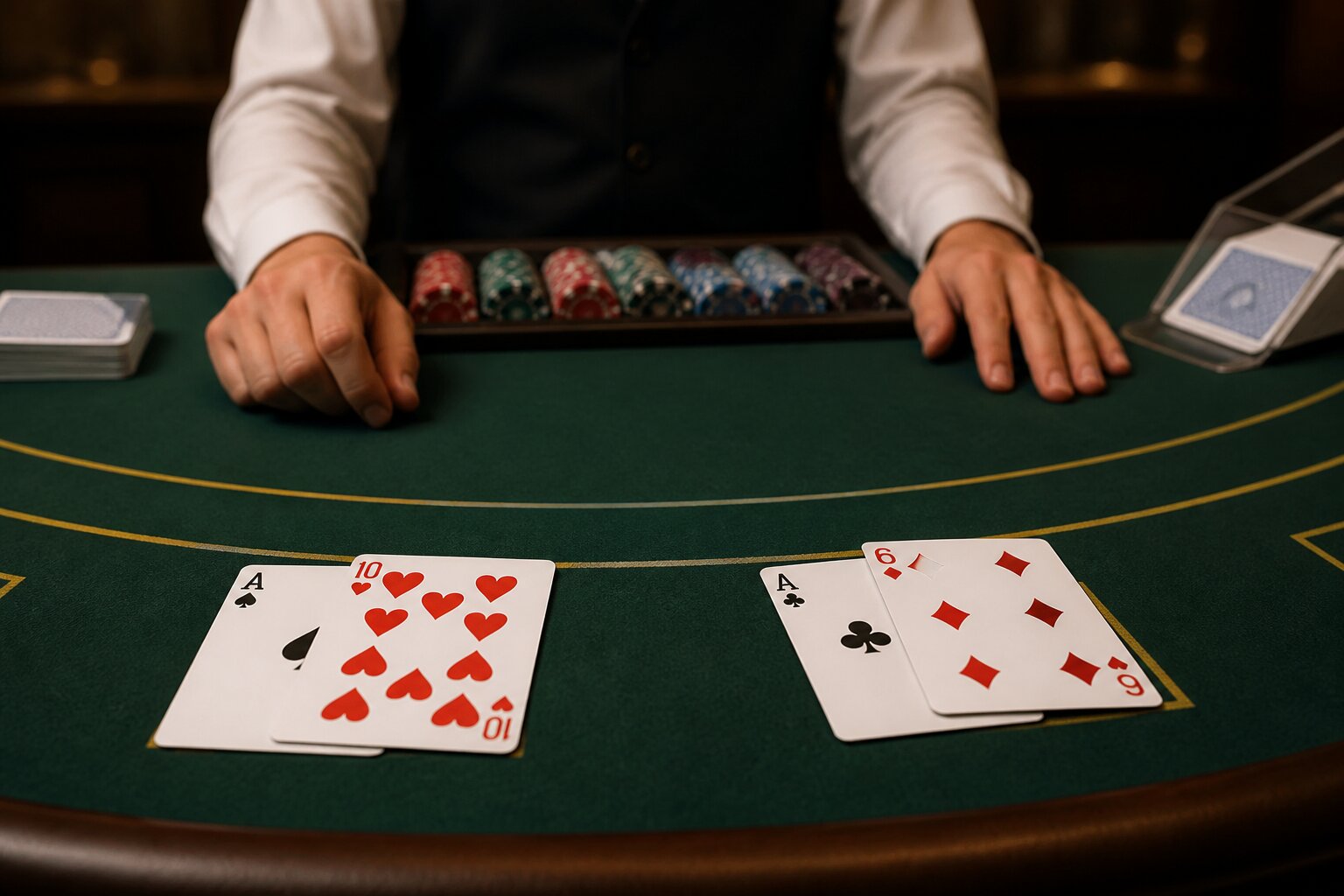
Blackjack is one of the most popular card games in the world, prized for its clear objectives and quick rounds. Whether at a casino table or on a screen at home, knowing how the game begins makes the rest of the play much easier to follow.
If you’ve ever wondered exactly how many cards each player gets at the start, how those first cards are shown, and what they mean for the hand that follows, this article will answer that and clarify some of the common confusions that surround the opening deal. Read on for a concise, practical guide to the opening phase of a blackjack round.
What Are the Basic Blackjack Dealing Rules?
Every round of blackjack begins the same way: each player receives two cards and the dealer receives two cards. Players’ cards are usually dealt face up so each person can see their own hand. The dealer’s cards are shown differently: one card is face up and the other is face down.
Card values are straightforward. Numbered cards count at face value, Jacks Queens and Kings count as 10, and Aces can count as 1 or 11, whichever benefits the hand without causing the total to exceed 21. After the initial deal, players decide whether to take more cards or to keep their current total, and the dealer resolves their hand last under the house rules in play.
Operators must provide safer-gambling tools such as deposit limits and self-exclusion; these tools help players manage their play responsibly. With those basics clear, the next section explains precisely how the opening deal is handled in different settings.
How Does the Initial Deal Work?
The initial deal is intended to be transparent and consistent. Each player gets two cards, almost always face up, and the dealer gets two cards with one kept face down until it is time to reveal it. That face-down card is commonly known as the hole card and is the single element of hidden information at this stage.
In physical casinos cards may be dealt from a shoe or shuffling machine, while online games use certified random number generators to replicate the same distribution. The method does not change the start: two cards per participant, one dealer hole card, and the values assigned as noted earlier. Once every player has their initial cards, the round moves into the decision phase where players weigh whether to take additional cards or not. This leads naturally into looking at how player and dealer cards differ visually and in practice.
Player and Dealer Card Differences
The main distinction between player and dealer cards is how they are shown. Players’ cards are visible so each person can assess their hand, whereas the dealer shows just one card, keeping the other concealed. This arrangement creates information asymmetry that affects how players choose to continue.
The hidden dealer card remains on the table and is revealed when it is the dealer’s turn to play, according to whatever house procedures apply. Online interfaces mirror that behaviour with clear graphics so the same decision dynamics are preserved whether the game is live or digital. Understanding these differences helps explain why players must make choices with incomplete information, and sets up the next topic: whether you can add more cards after the initial deal.
Can You Get More Cards After the Start?
Yes. After the initial two cards, players can request additional cards to improve their total, a choice called hitting. Each hit gives one extra card, and players can take further hits until they either choose to stop or exceed 21. When a hand goes over 21 the player busts and their turn ends.
Players also have the option to stand and take no more cards. In many versions of the game further options such as doubling down or splitting pairs are available, but these are decisions that follow from the initial two-card hand rather than changing the opening deal itself. Knowing how to manage additional cards depends on understanding the initial hand values, which is explained next.
How Is the Value of the First Hand Determined?
The value of the opening two-card hand is simply the sum of the two cards using the standard values: numbered cards at face value, face cards at 10 and Ace as 1 or 11. The Ace’s flexibility makes it a special case because it can be counted in whichever way makes the hand closest to 21 without exceeding it. For instance, an Ace with a 7 can be read as 8 or 18, allowing players to adapt as they take more cards.
If the two cards add to 21—specifically an Ace and any 10-point card—that is called a blackjack and is the strongest possible starting hand. Other starting totals set the scene for whether a player will take more cards or use other permitted options, and also influence how players read the dealer’s visible card when deciding how aggressive to be.
Common Misconceptions About Starting Cards in Blackjack
There are a few misconceptions worth clearing up. First, the number of starting cards is fixed: two for each player and two for the dealer. No variation in that count occurs as part of the standard rules. Second, while the dealer’s face-down card is unseen, it is not treated differently in value or rank; it simply remains hidden until revealed.
Another mistaken idea is that the starting hand determines everything. In truth the opening two cards are a starting position from which the round develops; subsequent choices and specific house rules shape the outcome. Finally, pairs do not change the fact that everyone begins with two cards, though certain pair combinations may allow splitting later on. With the common confusions addressed, it helps to consider how different house rules can subtly influence the game’s early stages.
How Do House Rules Affect the Deal?
House rules do not alter the basic fact that each participant starts with two cards, but they can change peripheral details that affect strategy and odds. The more decks can affect the likelihood of particular card combinations appearing. Some venues restrict or permit particular options such as doubling after splitting, or they may only check the dealer’s hole card for blackjack under certain up-card conditions.
These variations do not change how many cards are dealt at the start, but they do affect decisions that follow the opening deal. It's sensible to acquaint yourself with the specific rules of the table or platform being used so that choices about hitting standing doubling and splitting are taken with full knowledge of any variations. With those considerations in mind you can approach each round knowing both the fixed elements and the variables that might affect play.
**The information provided in this blog is intended for educational purposes and should not be construed as betting advice or a guarantee of success. Always gamble responsibly.