
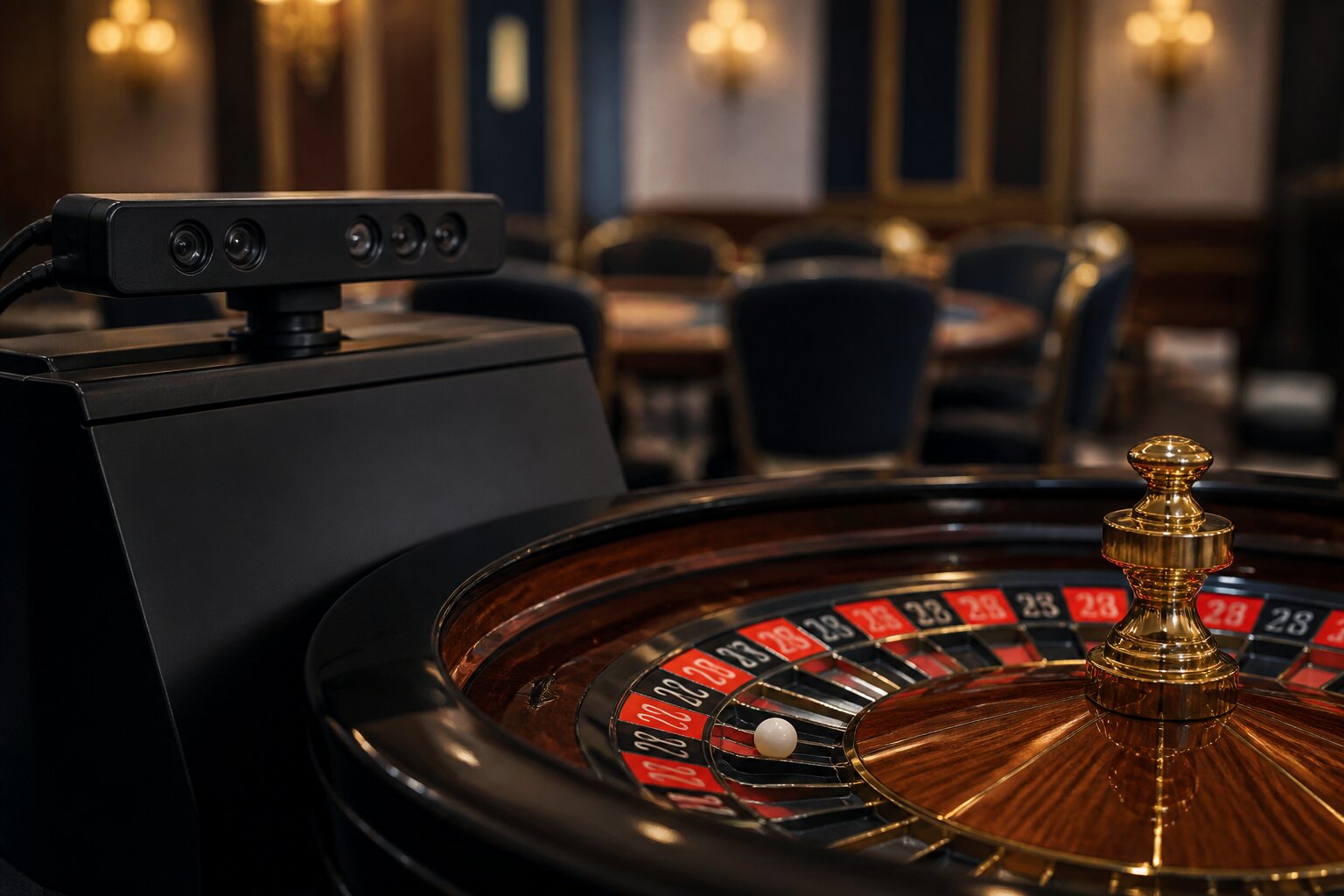
Ever wondered if there’s a way to gain an edge at the roulette table? Prediction computers promise just that, claiming to read the wheel and give players an informational advantage.
These small devices have inspired headlines, court cases and film plots. This article takes you through what they are, how people try to use them, how casinos respond and what the legal position is in the UK.
If you want a clear picture of the technology and the risks around it, read on for a practical, courtroom-to-casino view of roulette prediction devices.
What Is a Roulette Computer Device?
A roulette computer device is a compact gadget intended to estimate where the ball may land by measuring elements such as wheel rotation and ball speed. Users feed timing or position data into the device, which runs quick calculations and returns a suggestion — sometimes via an earpiece, vibration or a small display.
These devices rely on physics and timing: consistent spin speeds, accurate input by the operator and minimal interference. Any variation — a slightly different dealer technique, a maintenance adjustment to the wheel, or a missed tap when entering data — reduces the device’s predictive power. In short, they attempt to turn observed physical behaviour into a statistical advantage, but that process is fragile and easily disturbed.
Using such tools in a casino context is treated as seeking an unfair advantage. The legal framework in the UK makes attempting to use a device that could influence game outcomes a criminal offence; casinos also prohibit their use under house rules.
How Do Prediction Computers Attempt to Work in Casinos?
Prediction computers depend on capturing precise moments during a spin. The operator notes or signals when the ball or wheel passes a reference point; the device uses those timings to estimate the ball’s deceleration and the wheel’s rotation, then projects where the ball is most likely to settle relative to the wheel.
Because calculations must be made within seconds, the user’s timing and the device’s processing speed are critical. Some systems simplify predictions to a segment of the wheel rather than an exact number, advising bets on a cluster of pockets rather than a single slot. Even so, any deviation — an altered launch speed, a change in table conditions — undermines those estimates.
Casinos view such attempts very strictly. Beyond the legal risk, staff training and surveillance are aimed specifically at spotting abnormal behaviours associated with these devices.
How Are These Devices Used in a Real Casino Setting?
In actual use, operators try to keep devices hidden and inputs subtle. The gadget may be concealed in a pocket, strapped to the body, or disguised as an everyday item; feedback is communicated discreetly to the user so bets can be placed without drawing attention.
Predictions are often converted into a bet on a group of numbers rather than a single pick, which can make any potential edge less obvious and betting patterns less predictable. Users typically alter their staking to appear natural and avoid obvious patterns that could alert staff.
Because the practice is prohibited, casinos routinely combine surveillance with procedural countermeasures — for example, varying dealer technique or performing equipment checks — to prevent any system from operating effectively in the long term.
Are Roulette Computer Devices Legal in the UK?
Using a prediction device in a UK casino is unlawful. The Gambling Act and accompanying regulations prohibit the use of tools or methods that give someone an unfair advantage at a game. That prohibition covers both visible and concealed devices and applies to actions aimed at influencing outcomes.
Licenced venues are required to enforce these rules and to report any suspected offences. The legal framework is designed to keep play fair and to protect the integrity of games for all patrons.
Penalties & Legal Consequences for Using Prediction Devices
Consequences for detected use can be severe. Staff may remove players from the premises and impose lifetime bans, and operators can involve the police. Criminal prosecution can lead to significant fines and custodial sentences where the evidence supports such action.
Casinos also maintain civil controls — confiscation of equipment, refusal of service and sharing of information with other venues — which can restrict a person’s ability to enter multiple establishments. The combined effect of legal and operational sanctions means the risks of using prediction devices are substantial.
How Effective Are Prediction Computers in Practice?
In practice, their effectiveness is limited. Modern casino equipment is maintained to minimise wheel bias and to ensure consistent operation. Dealers are trained to vary spin and ball release techniques where necessary, and surveillance helps identify any long-running patterns.
Even when a device produces plausible predictions in controlled testing, translating that into sustained, profitable play in a live casino is difficult. Small errors in timing or input, equipment adjustments or dealer variations can rapidly degrade performance. Some users report short runs of favourable outcomes, but these are seldom repeatable or reliable over time.
Ultimately, attempts to use predictive devices face technical, procedural and legal barriers that together make long-term success improbable.
Do Casinos Detect and Counteract Prediction Devices?
Casinos actively monitor for cheating methods, including prediction devices. Surveillance teams look for unusual body movements, odd betting patterns and other indicators. Regular equipment inspections and random checks of play are part of standard procedures to ensure no gadget has an opportunity to work undetected.
If staff suspect device use, they respond by removing players from the table, examining equipment, and escalating incidents to management and, where appropriate, law enforcement. Information sharing between venues also helps prevent known offenders from moving from one casino to another.
These measures are designed to protect fairness and to maintain an environment where all players can expect consistent rules of play.
Common Myths About Roulette Prediction Computers
There are several persistent misconceptions about prediction devices, partly fuelled by fiction and online claims. Addressing these helps separate realistic expectations from exaggerated claims.
Myth: These devices guarantee wins
No device can provide certainty. While some may offer a probabilistic edge under tightly controlled conditions, real-world variables rapidly reduce their effectiveness.
Myth: Casinos can’t spot prediction devices
Modern surveillance, staff training and routine checks make it much harder to use concealed gadgets without detection. Casinos are vigilant for the specific behaviours associated with these methods.
Myth: Using a device is a harmless loophole
Attempting to exploit a casino with a device is treated not as a clever workaround but as an offence against fair play and the law; consequences reflect that stance.
Knowing the limits of these devices and the likely consequences of attempting to use them helps anyone make informed choices about how they engage with casino games.
We hope this article has clarified how roulette prediction devices are supposed to work, the practical obstacles they face, and the legal and operational barriers in place to prevent their use. If you have further questions about game integrity or casino procedures, we’re here to help.
**The information provided in this blog is intended for educational purposes and should not be construed as betting advice or a guarantee of success. Always gamble responsibly.