
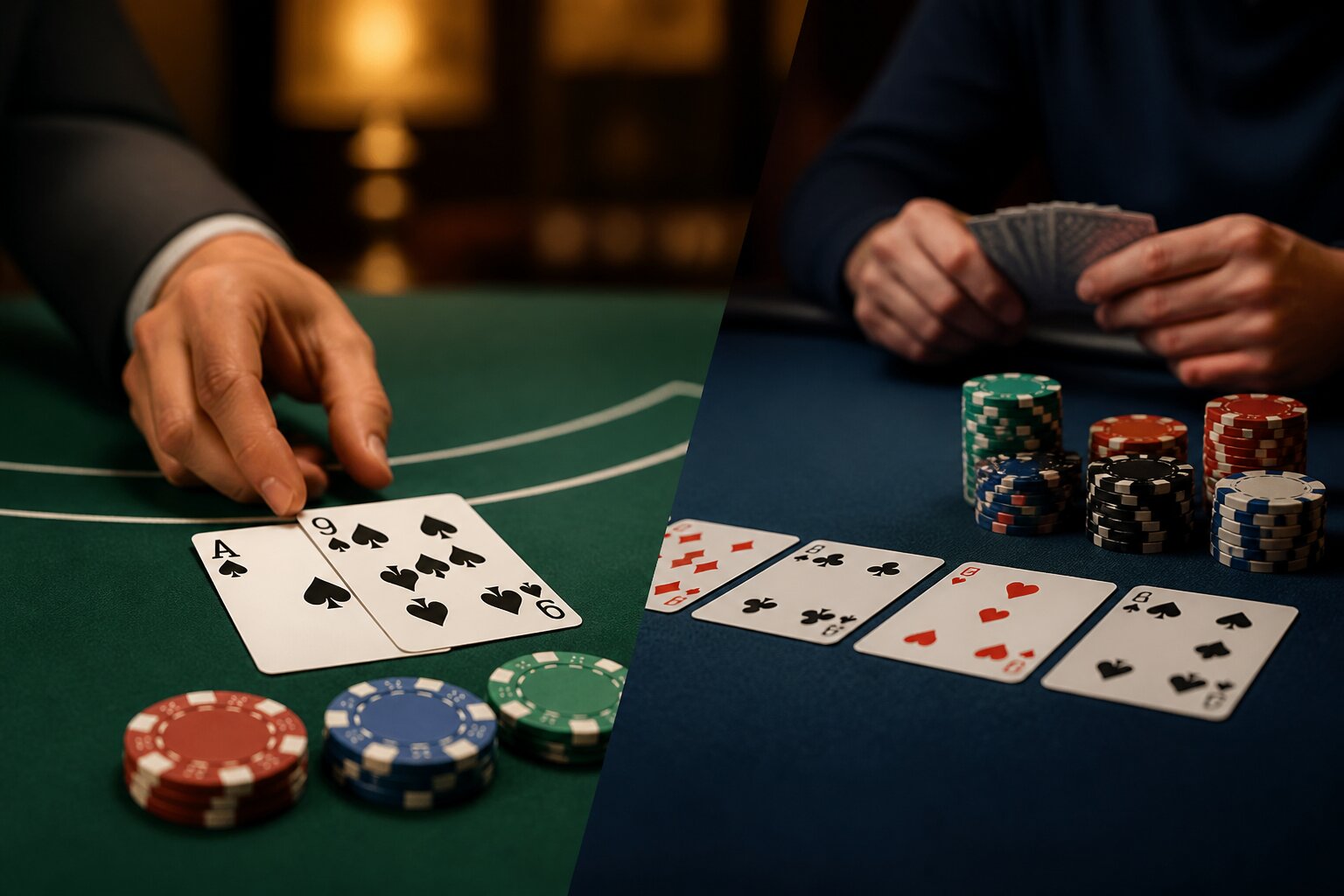
Ever wondered if blackjack and poker are actually the same game, or if people simply use the names interchangeably? With both appearing at casinos and online, it’s easy to see why they’re confused.
On the surface they share cards, chips and a sense of tension, but the games unfold very differently once you start playing. Read on to see what separates them, and which might suit you better.
What Are Blackjack and Poker? Defining the Basics
Blackjack and poker are two distinct card-game families with different aims and rhythms. Blackjack, commonly known as 21, is a quicker game in which each player tries to achieve a hand value nearer to 21 than the dealer without exceeding it. Decisions are largely numerical — whether to take another card or stick — and each player’s result is settled against the dealer’s hand.
Poker covers a variety of games, such as Texas Hold’em or Omaha, where players compete against each other rather than a dealer’s hand. Success comes from forming valuable card combinations or using betting and bluffing to persuade opponents to fold. Poker rounds include multiple opportunities to bet and react, so the session’s tempo is generally slower and more strategic.
Both use standard playing cards, but the objectives, interaction and flow make the experiences quite different. Next, we’ll look at how each game is actually played so you can picture what a typical session feels like.
How Are Blackjack and Poker Played?
Although they share a deck, the structure of play sets blackjack and poker apart. Blackjack unfolds as a series of independent contests between each player and the dealer, with a clear numerical target to reach. Players typically start with two cards and choose whether to draw more, stand, double down or take other options permitted by the table rules. Dealers operate to fixed rules for drawing or standing, so players’ choices are about managing the probability of improving their own hand.
Poker sessions start with players receiving private and, in some versions, shared community cards. Betting rounds create a tactical environment where decisions about calling, raising or folding influence the size of the pot and the behaviour of opponents. Winning depends either on holding the best hand at showdown or on convincing other players to fold through strategic betting. The social interaction and psychological element are integral: reading opponents and timing bets are as important as the cards themselves.
Understanding these mechanics makes the contrast clear: blackjack tests numerical decision-making against a set standard, while poker tests social and strategic skill across multiple exchanges. With that difference in mind, we can now examine the specific objectives of each game.
The Goal of Blackjack
In blackjack, the objective is straightforward: achieve a hand total closer to 21 than the dealer without exceeding 21. Number cards carry their face value, face cards are worth ten, and the ace can count as one or eleven depending on what best serves the hand. Each player’s result is independent, so decisions focus on how to manage the current hand against a known dealer procedure rather than on influencing other players.
The Goal of Poker
Poker’s aim is to win the pot by either holding the strongest hand according to standard poker rankings or by driving other players to fold through betting pressure. Hands are valued by combinations — pairs, straights, flushes and so on — and the ace can serve as a high or low card depending on the variant. The repeated betting rounds create opportunities for strategy, from aggressive raises to subtle traps, and the interplay between cards and player behaviour defines much of the game’s appeal.
Key Differences Between Blackjack and Poker Rules
The rule sets shape how each game feels and what players are trying to achieve. Here are the central distinctions to watch for.
Decks and Card Values
Both games typically use a standard 52-card deck, though casinos often use multiple decks in blackjack to change deck composition and house procedures. Blackjack commonly employs a shoe that holds several decks and may be reshuffled only after a cut card appears, which alters the distribution of remaining cards and affects short-term probabilities. In blackjack, card values are immediately meaningful for reaching 21: number cards count at face value, face cards count as ten, and aces can count as either one or eleven depending on the hand. These fixed values and the immediate objective create a direct, numerical decision process for hitting, standing, splitting or doubling.
Poker treats individual card values as components of larger combinations, so the importance of a card depends on how it fits with others to form a ranked hand. Variants such as Texas Hold’em, Omaha or Seven-Card Stud use different numbers of private and shared cards, which changes hand construction and strategy. In poker there is no single numeric target to reach; instead the goal is to make the best possible combination relative to opponents’ hands, or to induce opponents to fold better hands. That emphasis on combinations and relative strength gives poker a different strategic texture from blackjack.
Player vs Dealer vs Player vs Players
Who you compete against is the clearest practical difference. Blackjack pits each player against the dealer, so other players’ hands do not affect your payout except insofar as seating, the dealer’s actions and any table limits. Each player’s decisions are largely independent, and the casino sets rules for dealer play that create a predictable framework. Poker is a contest among players; the house simply facilitates play, provides the venue and collects fees or a rake. Because the outcome depends on opponents’ choices, poker tables tend to produce far more interaction and strategic manoeuvring.
This structural contrast also shapes the social and psychological aspects of each game. Blackjack is more transactional and procedural, with decisions based on probability and established strategy charts. Poker is more interactive, allowing bluffing, reading opponents and adapting tactics over multiple hands. Both games involve skill and chance in varying proportions, but they test different abilities: blackjack rewards consistent, correct application of statistical strategy, while poker rewards long-term judgment about people, odds and bet sizing.
Are the Skills the Same for Both Games?
The mental demands in blackjack and poker overlap only partially. Blackjack rewards swift numerical judgement and familiarity with correct plays given a particular hand and dealer up-card. Learning basic strategy helps reduce the house edge and leads to more consistent decision-making, because choices are based on known probabilities and set dealer behaviour.
Poker demands a wider skillset. Probability and hand-value knowledge matter, but so do psychology, timing and bankroll discipline. Success can come from carefully managing bet sizes, reading opponents’ tendencies and choosing the right moments to apply pressure. Because outcomes hinge on both cards and how opponents react, poker often rewards longer-term study and experience.
Both games involve uncertainty in each round, so good decision-making and self-control matter in either setting. Now let’s look at how they translate into online play.
Can You Play Blackjack and Poker Online?
Digital platforms mirror the core experiences of both games while offering their own conveniences. Online blackjack retains the fast pace and straightforward choices, with digital interfaces that make standing, hitting or doubling intuitive. Poker rooms provide cash games and tournaments where players from many locations meet at virtual tables, with chat and timing features that affect table dynamics.
Operators are expected to uphold fair play and transparent rules. Age verification and identity checks are common, and many platforms provide tools to help players manage spending and time spent playing. These controls support a safer environment for people who wish to play either game online.
Having considered how the games run in person and online, it’s useful to address common misunderstandings that can influence expectations.
Are There Common Myths About Blackjack and Poker?
Both games attract myths that exaggerate how much can be predicted or guaranteed. One persistent idea is that fixed systems can ensure wins in blackjack; while strategic play improves expected results, no method removes the inherent randomness of card draws. Another misconception casts poker as solely bluffing; in reality, successful play blends hand selection, position, bet sizing and reading opponents over many hands.
Believing that past outcomes dictate future ones is also misleading. Each hand or deal is a fresh event, and patterns in prior rounds do not determine subsequent cards. Keeping these realities in mind helps set reasonable expectations and supports better decision-making at the table. Next, the final section will help you choose which game suits you best.
Conclusion: Which Game Is Right for You?
Deciding between blackjack and poker comes down to the kind of experience you prefer. Choose blackjack if you like faster rounds, clearer objectives and decisions grounded in numerical evaluation. Opt for poker if you enjoy prolonged interaction, psychological strategy and the challenge of outplaying opponents over many hands.
Whatever you play, treat it as entertainment and plan your sessions sensibly. Use available account tools to set limits and take breaks when needed; help is also available if gambling stops being enjoyable. With a clear sense of what each game demands, you can pick the one that fits your style and enjoy the play responsibly.
**The information provided in this blog is intended for educational purposes and should not be construed as betting advice or a guarantee of success. Always gamble responsibly.