
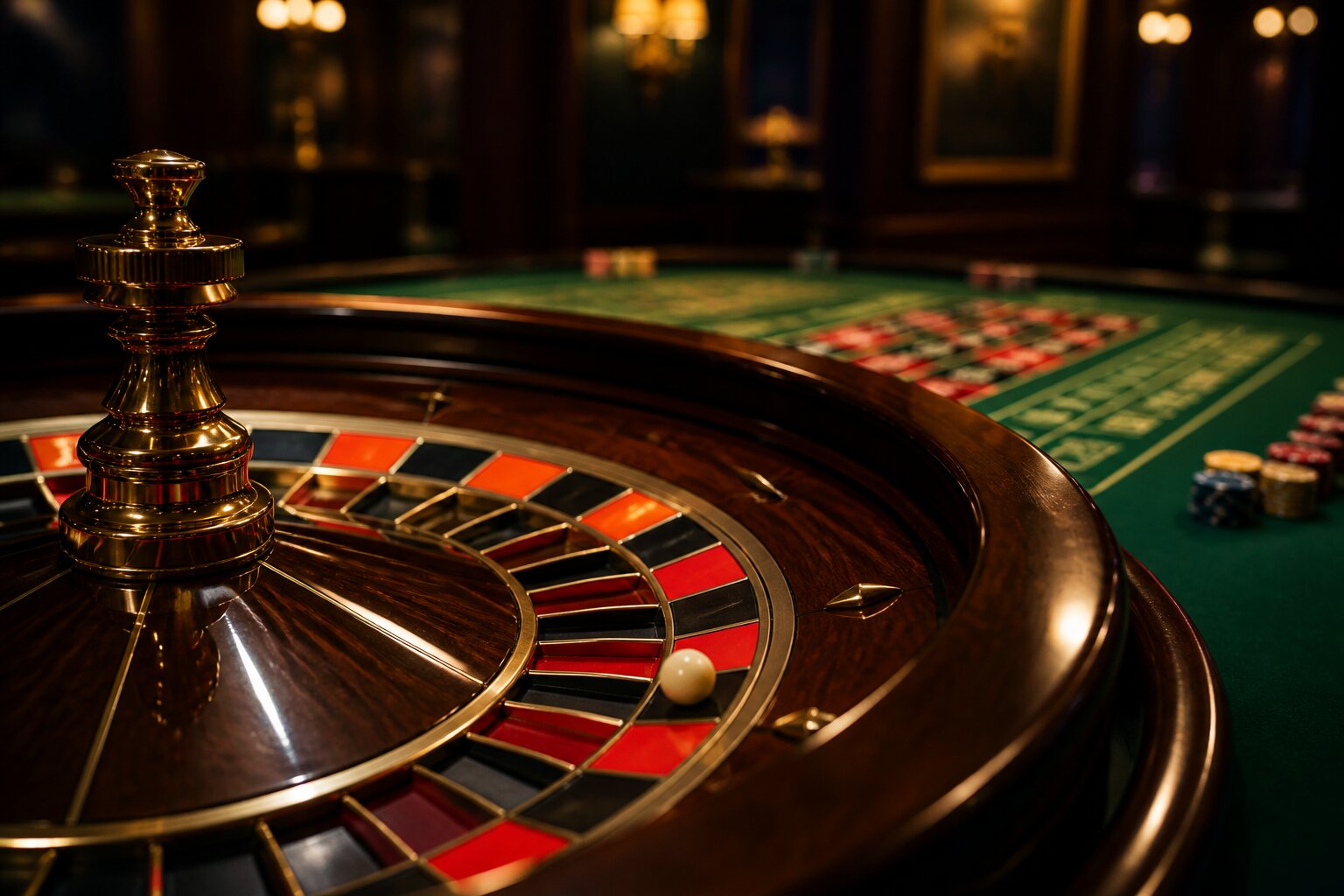
Ever wondered what the chances are of seeing the red pocket land several times in a row at the roulette table? Whether you’re a regular player or just interested in the maths, streaks can catch the eye and prompt questions about how likely they really are.
Many try to spot patterns or bet on the same colour because a run of reds can look persuasive. Understanding the underlying probabilities clarifies what to expect and helps avoid common misunderstandings.
Below we break the maths down step by step, compare wheel types, and show how to estimate how often streaks might appear in a session.
What Is The Probability Of Red On A Single Spin?
The probability of red on any given spin depends on the wheel you are using. Different wheel designs change the total number of pockets while the count of red pockets remains the same, so the chance of red varies accordingly.
A European roulette wheel has 37 pockets: numbers 1–36 and a single green zero. Eighteen of those pockets are red, so the probability of red on a single spin is 18 out of 37, which is about 48.65%.
An American wheel adds a double zero, making 38 pockets in total while still having 18 red pockets. That gives a single-spin probability of 18 out of 38, roughly 47.37%.
These single-spin probabilities set the baseline for all longer streak calculations, so it helps to keep them in mind as you read on. Small differences in the denominator produce slightly different percentages, and those differences become more noticeable when you model multiple spins or long-term outcomes.
Probability Formula For Red X Consecutive Spins
To find the odds of red appearing X times in a row, raise the single-spin probability to the power of X. This gives the probability of that exact streak occurring on consecutive spins.
The single-spin probability differs by wheel type:
- For a European wheel the expression is: (18/37)^X
- For an American wheel the expression is: (18/38)^X
Each spin is independent, which means the result of one spin does not change the probability on the next. Because of that independence you multiply the same single-spin probability for each spin in the streak, which is why the power notation is used.
The American wheel has a slightly lower chance of red for any given spin because it has an extra non-red slot compared with the European wheel. That difference carries through directly into the streak probability.
If you want to see the numerical example for three consecutive reds on a European wheel, it is (18/37) × (18/37) × (18/37), which equals (18/37)^3 and gives about 11.5%. Remember that past spins do not influence future spins, so a previous run of reds does not make another red more or less likely.
How Do European And American Wheels Differ In Odds?
The only structural difference that affects colour probabilities is the extra green pocket on the American wheel. That additional pocket reduces the proportion of red pockets to the total, so the probability of hitting red on any spin is slightly lower.
European roulette: about 48.65% per spin.
American roulette: about 47.37% per spin.
The difference is modest for a single spin but becomes more noticeable the more spins you consider. If you prefer the best available single-spin odds for colour bets, the European wheel is the better choice.
To keep things practical, remember that the zero pockets are the mechanism that gives the house its edge; they are the reason neither red nor black is exactly 50%.
How Does The Zero Affect Consecutive Red Probabilities?
Zero is neither red nor black, so when it appears it interrupts any run of colour results. That single green pocket on European wheels and the two on American wheels reduce the chance of any colour streak continuing.
Because zero outcomes break streaks, the expected frequency of long runs of red falls compared with a hypothetical wheel that had only red and black pockets. More zero pockets make sustained colour runs less likely.
This effect is cumulative: the lower the single-spin probability for red, the faster the probability of a long streak decreases as you raise that probability to higher powers.
How Likely Is Red X Times In A Row In Practice?
Long runs of the same colour do happen, but their likelihood drops quickly as X increases. For concrete context:
- On a European wheel, three consecutive reds have a probability of about 11.5%.
- Five consecutive reds on the same wheel are roughly 3%.
- On an American wheel, those same streaks are slightly less likely: around 10.6% for three and 2.4% for five.
These percentages show why long streaks draw attention: they are uncommon but not so improbable that they never occur. Interpreting them correctly helps avoid chasing patterns that have no bearing on future spins.
Now that you know how to calculate single-streak probabilities and how zero pockets affect them, you can estimate how often streaks might crop up in a playing session.
How To Calculate Expected Frequency Of X Reds In A Playing Session?
To estimate how many times a streak of X reds might appear during a session, multiply the number of possible starting positions for that streak by the streak probability.
The formula is:
Expected streaks = (Total spins − X + 1) × (probability of red)^X
For example, if you spin 100 times on a European wheel and look for runs of three reds, there are 98 possible starting points. With a three-red probability of about 0.115, the expected number of such streaks is 98 × 0.115 ≈ 11.3. That gives a useful sense of scale, though the actual count in any session will vary.
This calculation is an estimate, not a prediction. It treats each potential starting position as a separate trial and works well for getting a general expectation over many spins.
If you want a quick comparison between wheel types, apply the same method but use the appropriate single-spin probability for European or American wheels. The larger the session and the smaller the streak length, the closer empirical results tend to match the estimate.
Play within limits and be mindful of how you manage stake sizes. If gambling becomes a concern, seek support or use site tools to take a break or set controls.
**The information provided in this blog is intended for educational purposes and should not be construed as betting advice or a guarantee of success. Always gamble responsibly.