
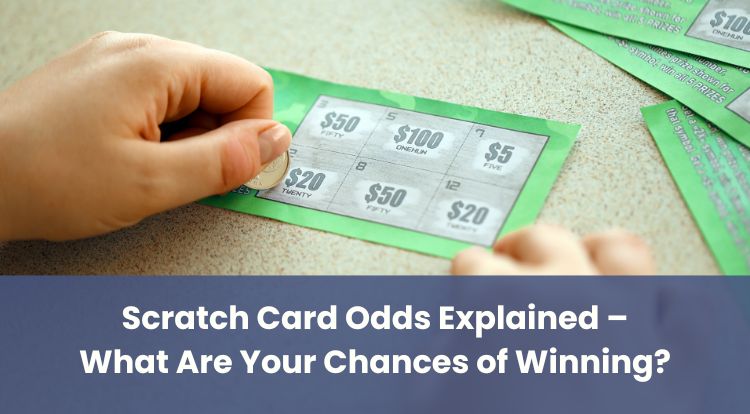
Scratch cards are popular, yet many people buy them without really checking the odds. A quick look at how those odds work can clear up a lot of confusion.
This blog post explains how odds are set, where to find them, how they differ by price and game type, and what payout percentages actually tell you. It also looks at how claimed prizes affect the remaining cards and tackles a few common myths along the way.
As with any form of gambling, only spend what you can afford and treat scratch cards as entertainment. Read on to learn more.
What Are My Chances Of Winning On A Scratch Card?
The odds of winning show how likely it is that a ticket will include a prize. They are set before printing, based on how many winning tickets are included in the total print run.
If the odds are 1 in 4, it means that across all the cards made for that game, one in every four contains a prize on average. It does not mean every fourth card sold will be a winner, because the cards are mixed.
Odds vary by game. Some higher-priced cards may come with better chances or larger prizes, but not always, so it is worth checking the numbers shown for each game before buying. With that in mind, where do these figures come from?
How Scratch Card Odds Are Calculated
Before a game launches, the provider decides the total number of tickets to print, how many of those will pay a prize, and the value of each prize tier.
From there, the overall odds are simply the count of winning tickets compared with all tickets printed. If 2,000 out of 10,000 tickets have a prize, the chance of getting any winning ticket is 1 in 5. Within that, each prize tier has its own frequency: small prizes are typically more common, while top prizes are intentionally rare.
These setups are designed and checked to meet regulatory standards so every ticket is produced to the same specification. Now that you know how the numbers are set, the next question is how to find them.
Are Odds Printed On The Ticket?
On most UK scratch cards, the odds of winning are printed on the back of the card or on the packaging. This usually shows the chance of winning any prize, not the chance of hitting the top prize. You might see something like “1 in 3.8 wins a prize.”
More detailed information is often available online, including a prize breakdown and how many prizes remain unclaimed. Checking these details helps you compare one game with another before you decide. Price and game style also matter, which brings us to the next point.
How Odds Vary By Price And Game Type
Odds are not the same across all games. Price and design both influence how a game is balanced.
Higher-priced cards often have slightly better overall odds or larger prize tables than cheaper cards, although there are exceptions. Some games are designed to offer frequent small wins that recycle part of your stake, while others put more of the prize pool into fewer, bigger payouts. The printed odds and prize breakdown give you a clear view of which approach a game takes.
Comparing a couple of cards side by side is useful: a £1 game might offer more frequent low prizes, while a £5 card may reduce those smaller wins and allocate more value to mid-range or top prizes. Price is only part of the picture, though. The game’s payout percentage explains how much of all stakes is returned as prizes overall.
How Do Payout Percentages Affect Your Chances?
Payout percentage, also called return to player (RTP), is the share of all money spent on a game that is paid back in prizes across the full print run. If a scratch card lists a 65% payout, it means that for every £100 spent on that game in total, £65 is paid out in prizes.
A higher payout percentage indicates that, across all tickets, more money is returned to players. It does not change the outcome for any single ticket, and it does not promise any individual will receive a certain return. Odds show how often winning tickets appear; payout percentage shows how the prize money is distributed over time. If you want a single number that blends those ideas into pounds and pence, expected value can help.
How To Calculate Expected Value For A Ticket
Expected value estimates the average return per ticket over the long run by looking at the entire prize pool and the number of tickets printed. It is another way of expressing what the payout percentage means in practical terms for one ticket.
Example Calculation For A £1 Ticket
Let’s say there is a £1 scratch card game with 1,000,000 tickets in total. For this example, the prizes and number of winners are:
1 prize of £100,000
10 prizes of £1,000
100 prizes of £100
10,000 prizes of £10
90,000 prizes of £1
The total prize pool is the sum of all prizes:
(£100,000 x 1) + (£1,000 x 10) + (£100 x 100) + (£10 x 10,000) + (£1 x 90,000) = £100,000 + £10,000 + £10,000 + £100,000 + £90,000 = £310,000
Dividing the prize pool by the number of tickets gives the expected value per ticket:
£310,000 ÷ 1,000,000 tickets = £0.31
So, on average, each £1 ticket returns 31p in prizes across the whole print run. Most tickets will not win, and returns are unevenly spread between them. One last twist is what happens once some of those prizes have already been claimed.
Do Odds Change After Big Prizes Are Claimed?
The odds printed on a card are based on the original mix of winning and non-winning tickets for that game and do not change on the physical ticket. However, your practical chance of finding a top prize can fall if the biggest wins have already been claimed and those winning tickets are no longer in circulation.
Many providers publish updates showing which major prizes have been claimed and how many remain. If top prizes are important to you, it is worth checking the latest figures before buying. These points often lead to a few widespread beliefs, so let’s clear those up.
Common Myths About Scratch Card Odds
One myth is that some shops are better places to find winners than others. In practice, tickets are distributed without targeting specific outlets, and the outcome on each card is fixed at production.
Another belief is that buying several tickets in a row improves your chance. Consecutive purchases do not change anything, because each card is already designated as a winner or non-winner before it reaches the till.
Some players avoid a game after hearing that a big prize has been claimed, while others rush to finish a roll. Neither approach changes the overall setup. What matters is how many top prizes, if any, are still unclaimed and available.
There is also the idea that certain times of day or busy locations offer better opportunities. The timing and venue of purchase do not affect the outcome, which is determined during printing.
If you choose to play, keep it within a set budget and treat it as entertainment. If gambling starts to affect your well-being or finances, seek support early. Organisations such as GamCare and GambleAware provide free, confidential help. Understanding the numbers behind scratch cards makes it easier to decide when to take part and when to step back.
**The information provided in this blog is intended for educational purposes and should not be construed as betting advice or a guarantee of success. Always gamble responsibly.