
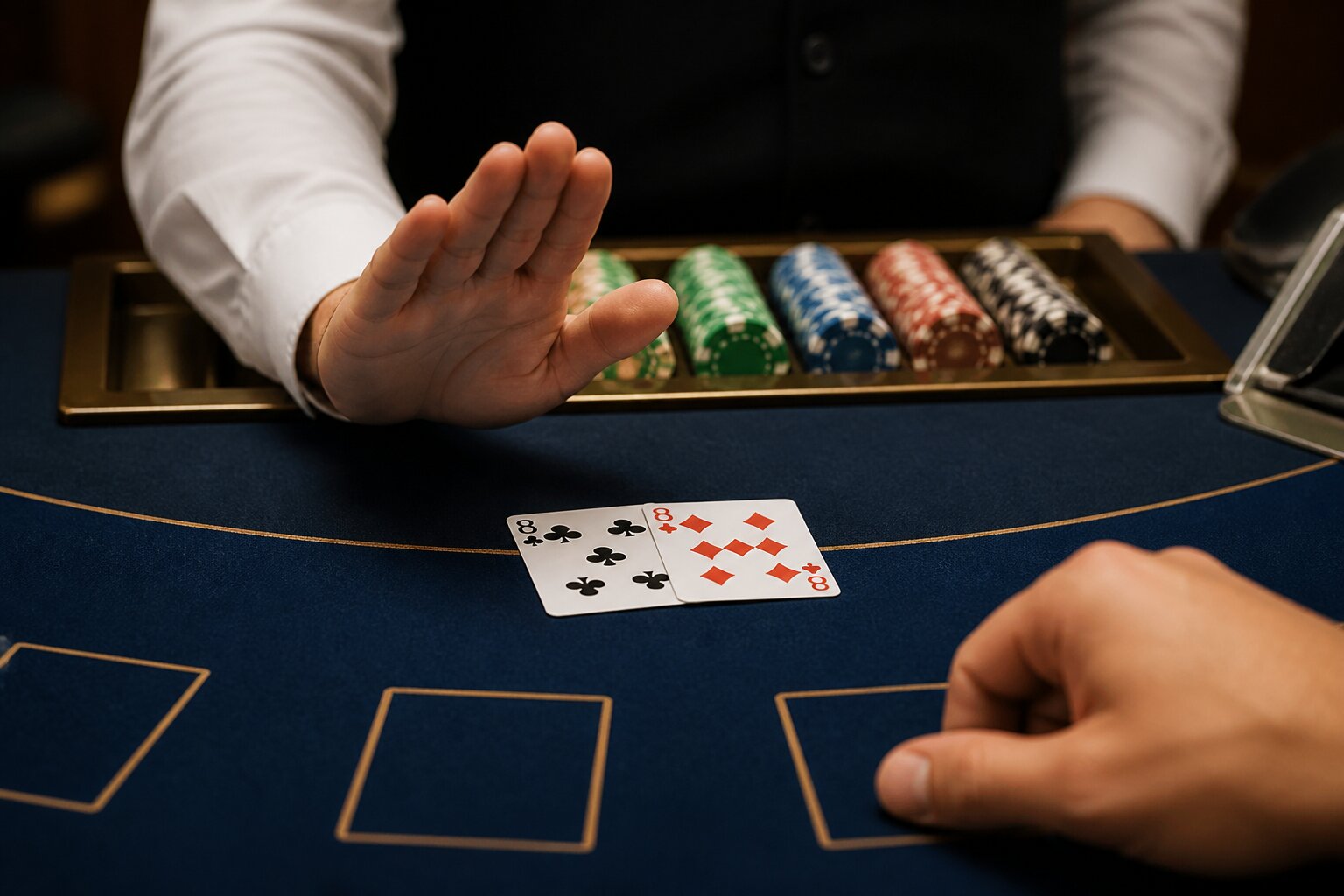
Whether you’re new to blackjack or just want to brush up on your casino knowledge, learning the lingo helps you feel confident at the table. Terms like “push,” “hit” and “stand” come up constantly, but understanding what they mean and how they affect play will stop you being surprised when the dealer calls a result.
This guide explains what a push is, why it happens, how casinos handle it, and how it interacts with other blackjack rules. Read on to learn the practical details that make the game easier to follow and more enjoyable to play.
What Is a Push in Blackjack?
A “push” occurs when the player and the dealer finish a round with the same hand total. When that happens the round is a draw: you do not win, but you also do not lose, and your original bet is returned.
A push can arise whether totals are made with the initial two cards or after taking additional cards. Typical matching totals are 18, 19, 20 or 21, including natural blackjack when both sides have an ace plus a ten-value card. The dealer collects no winnings and no deduction is made from the player’s balance; the hand simply ends and play continues with the next round.
To see why that tie happens, next we’ll look at the rules and mechanics that make pushes a natural part of the game.
Why Do Pushes Occur in Blackjack?
Pushes are a built-in outcome of how blackjack is played. Both player and dealer aim for a total as close to 21 as possible without exceeding it, but the dealer must follow fixed rules about when to draw and when to stand. Those rules, plus the player’s decisions, produce a range of possible final totals—sometimes those totals will match.
Because the cards are dealt from a shuffled shoe or virtual deck, matching totals are a statistical possibility on every hand. The dealer plays to predetermined thresholds—commonly hitting until reaching 17 or higher—while the player chooses their own actions. When those independent processes end at the same number, a push results.
Understanding these mechanics makes it easier to accept pushes as part of the flow rather than a rare anomaly.
Common Scenarios Leading to a Push
Pushes tend to appear in a few recognisable situations. These examples show how typical play sequences can lead to a tied outcome.
One common scenario is the dealer drawing to reach the player’s standing total. For example, if a player stands on 20 and the dealer takes additional cards until also making 20, the hand is a push. This can occur with any matching total as long as neither side busts.
Another frequent case is when both player and dealer are dealt a natural blackjack on the first two cards. When both have an ace and a ten-value card, the hand is automatically a tie and the player’s stake is returned.
Knowing these scenarios helps explain how casinos handle the outcome, which is what follows.
How Are Pushes Handled at UK Casinos?
Licensed casinos in the UK follow standard procedures when a push occurs. The player’s original stake is returned in full and no winnings are paid out for that hand. This applies in both online and land-based settings, with the outcome presented clearly at the end of the round.
In online play the system updates your balance immediately; in a physical casino the dealer simply returns the chips or credits. Operators are required to resolve tied hands consistently, so there is no ambiguity about a push and the next betting round proceeds as normal.
These consistent practices maintain transparency for players and ensure the outcome is resolved promptly and fairly.
Impact of a Push on Your Winnings
A push leaves your overall balance unchanged for that particular hand: the stake is refunded and there is no profit or loss recorded from the round. This neutral outcome neither advances nor hinders your session results, it just resets the position for the next decision.
The clean handling of pushes also helps players keep an accurate view of how much they have put at risk and what remains available to play. When managing a session, knowing that a tie simply returns your stake can make it easier to plan your next bets without being influenced by an unresolved result.
To make the game easier to follow, it’s helpful to know the standard terms that will keep appearing at the table.
Understanding Key Blackjack Terms
Familiarity with basic terminology makes the action and decisions clearer. A hand is the set of cards dealt to a player or the dealer. Hitting means taking another card; standing means keeping your current total. Busting is exceeding 21, which ends that hand in a loss for the player.
A blackjack refers to an ace paired with a ten-value card on the initial two cards, which is the highest possible two-card hand. The dealer is the person or automated system representing the house and acting under fixed drawing rules. A bet or stake is the amount risked on each hand.
Push is the term used when the player’s and dealer’s final totals match, and it results in the stake being returned. These terms will recur throughout the examples and explanations here.
With those basics covered, it helps to see how pushes interact with other optional rules you might encounter.
How Do Pushes Affect Other Blackjack Rules?
Pushes coexist alongside options such as surrender and insurance, but each is settled independently. Knowing how they relate avoids confusion about outcomes when several options are in play.
Surrender lets a player give up a losing-looking hand early in exchange for a partial refund, normally half the bet. That disposal happens before the final comparison of hands and is separate from a push, which only arises after both hands are complete.
Insurance is a side wager offered when the dealer’s face-up card is an ace; it pays if the dealer has a natural blackjack. If the main hand later becomes a push, the main bet is refunded while the insurance wager is resolved on its own terms. Each wager is treated distinctly so players can see clearly which bets win, lose or push.
With those interactions in mind, it’s useful to clear up a few misconceptions many players have.
Misconceptions About the Push Rule
A push is neither a bonus nor a penalty; it is simply a draw with the stake returned. Some players assume pushes are rare or that they can be avoided with particular strategies. While strategic choices shape your expected outcomes, a tie is just one possible result of independent card draws and set dealer rules.
Another mistaken belief is that different operators handle pushes differently. In regulated environments the treatment of ties is standardised, so the same basic result applies across venues: your bet is returned and the hand ends.
It’s also not possible to influence a push once hands have been played; decisions made during the round affect probabilities, but they do not guarantee a particular end result when a tie occurs.
Do Online and In-Person Blackjack Games Treat Pushes Differently?
The treatment of a push is the same whether you are playing online or at a physical table. In online games, the platform updates balances instantly and automatically, returning your stake to your account without any manual action. In-person play involves the dealer returning chips or credits to you, which can take a little more time but results in the same outcome.
The rules that govern a tie do not change with the format, so the experience of a push remains consistent across both environments. That consistency also applies to how pushes affect the running total of wins and losses for that session, though online platforms may record and display this information more clearly in your game history.
If you still have questions, the short FAQ below covers common points and clarifies how pushes interact with side bets and with record keeping. In many casinos and on most platforms, a push applies only to the main hand and usually does not resolve side bets unless those bets specifically state otherwise.
Is my bet lost when there is a push in blackjack?
No. When a push occurs the original stake is refunded in full and the hand is recorded as a draw.
Does a push count as a win for the player?
A push is not recorded as a win or a loss; it is a neutral result and does not change your balance from the amount staked that hand.
What happens to side bets during a push?
Side bets are resolved independently of the main hand. For example, an insurance wager is settled on whether the dealer has a blackjack, regardless of the main hand finishing as a push.
Are pushes handled the same way at every UK casino?
Yes. Licensed operators apply the same standard for resolving ties: the player’s stake is returned and the round is treated as a draw. This consistent approach keeps outcomes transparent and fair across different games and venues.
Pushes are a routine part of blackjack and, while they neither win nor lose you money, understanding them removes the uncertainty when they happen. With this clarity, you can follow the action confidently and focus on the decisions that shape each hand.
**The information provided in this blog is intended for educational purposes and should not be construed as betting advice or a guarantee of success. Always gamble responsibly.