
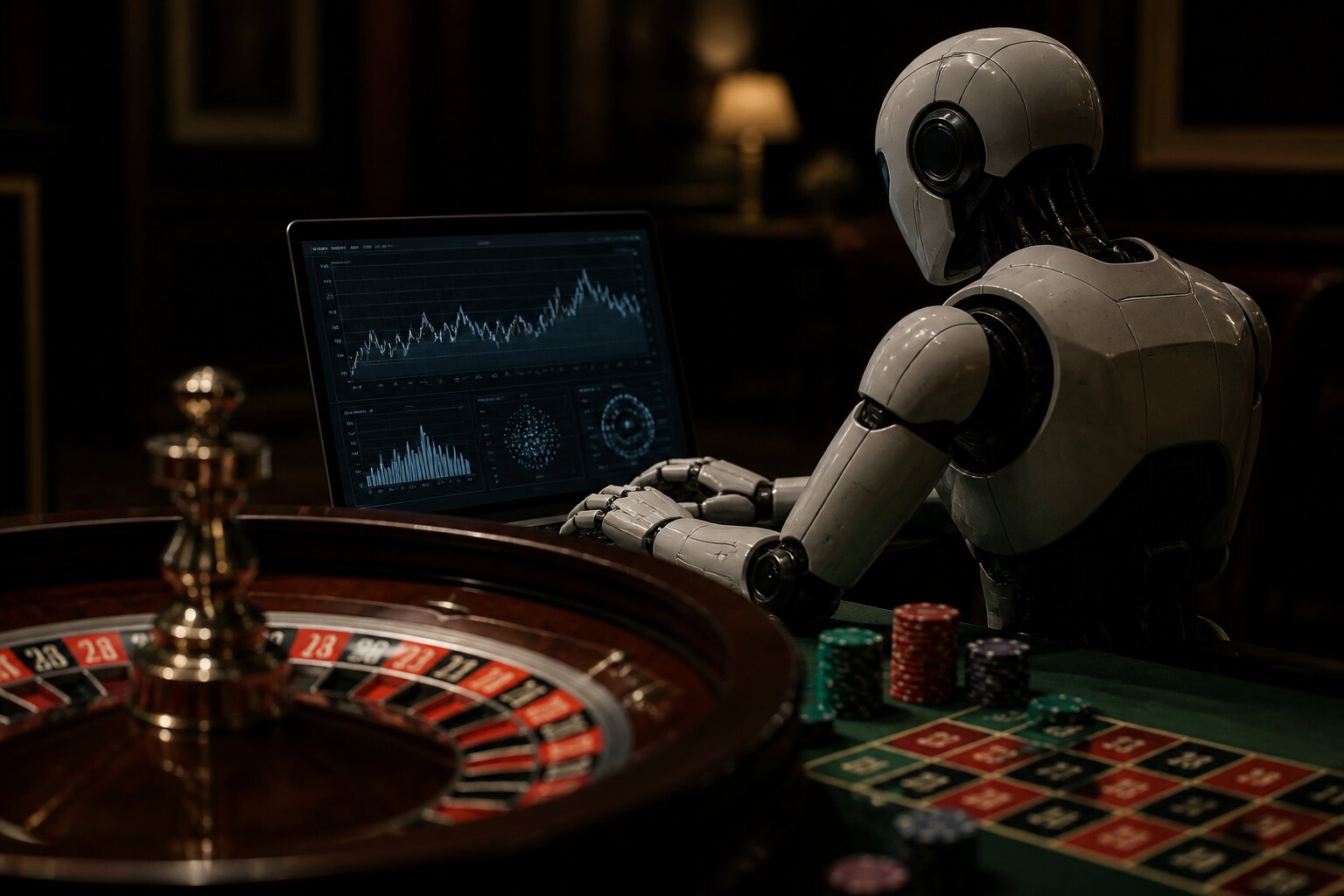
Roulette is a classic casino favourite, built around a simple but compelling question: where will the ball stop? Recently, advances in artificial intelligence have prompted fresh debate about whether computers can spot patterns humans miss.
This article separates fact from fiction, exploring how machine learning and automation interact with both live and online roulette. Read on to understand what current technology can and cannot do, and what the practical and regulatory limits are.
How Does Roulette Work?
Roulette is a table game where players place bets on which pocket a small ball will fall into after a wheel is spun. Standard wheels are numbered 1 to 36 with red or black pockets, and typically include a green zero. In a land-based game a dealer spins the wheel and rolls the ball the other way; in online versions the same basic outcome is produced by a certified random number generator, which simulates the spin digitally.
Players can bet on single numbers, colours, odd or even, or groups of numbers such as dozens and corners. These different bet types carry fixed mathematical odds. For example, a straight up bet in European roulette covers one of 37 pockets, and simpler bets such as red or black are close to even money but remain slightly unfavourable due to the zero.
Because each spin is resolved independently, previous results do not alter the underlying probabilities. The systems that generate results, whether mechanical or electronic, are subject to rigorous testing and oversight to ensure they behave as designed. Next, we’ll look at how AI is used in gaming more broadly and why it cannot change those built-in probabilities.
What Is Artificial Intelligence in Gaming?
Artificial intelligence covers computer systems designed to perform tasks that would otherwise need human judgement. In gaming, AI is mainly used to improve the player experience, detect irregular activity, and support operational tasks.
Examples include chatbots that respond to customer questions, recommendation engines that suggest games based on prior activity, and monitoring tools that flag unusual account behaviour. Operators also apply AI to strengthen security, for instance by spotting suspicious login patterns or potential fraud.
Crucially, these applications work alongside the systems that run games; they assist with service and oversight rather than altering game outcomes. With that distinction clear, we can explore whether machine learning techniques used elsewhere might be applied to analyse roulette spins.
Can Machine Learning Analyse Roulette Spins?
Machine learning specialises in finding patterns in large datasets and making probabilistic predictions. Applied to roulette, programmes could attempt to study long series of results to identify trends or biases. In physical casinos some hobbyists have tried high-speed recording to capture the motion of wheel and ball, hoping to detect slight mechanical irregularities.
However, online roulette spins come from certified random number generators, and even well-maintained physical wheels are subject to regular calibration and checks. As a result, the useful signals that machine learning needs to make reliable predictions are generally absent. When the data source lacks any systemic bias, pattern-seeking models will at best fit noise rather than produce replicable forecasts.
Types of Data Analysed by AI
AI systems trying to analyse roulette might examine several sources of data, such as:
- spin results, including winning numbers and colours
- the position or speed of the wheel and ball in physical games
- timing between spins
- observable dealer routines in live settings
In practice, only physical-wheel observations could ever offer the tiny imperfections a model might exploit, and those are rare because venues maintain equipment to prevent such biases. The next section describes common machine learning methods and why they fall short when applied to roulette.
Common Machine Learning Approaches
Typical approaches include regression, which looks for relationships between variables, and pattern recognition, which searches for repeating sequences. In principle, these techniques can detect subtle biases in experimental data, and historically there have been isolated cases where physical defects produced exploitable tendencies.
Despite that, applying these methods to regulated games provides little success. Online results are deliberately unpredictable, and live wheels are monitored and serviced to remove the kinds of mechanical quirks that models would need. Claims that machine learning can reliably predict roulette outcomes, especially online, are not supported by controlled evidence.
If machine learning cannot generally predict spins, some turn to automation instead. The next section explains how roulette bots operate and what they can and cannot achieve.
Roulette Bots: How Do They Operate?
Roulette bots are programmes that automate play, placing bets and recording results according to pre-set rules or algorithms. They can react faster than a human, follow complex betting patterns, and maintain long logs of outcomes for analysis.
Typically a bot will interact with a casino’s interface to place wagers, adjust stake sizes following a chosen progression, and track recent numbers. Popular strategies implemented by bots include systems that increase stakes after losses or scale bets according to a mathematical sequence.
Key features and operations of roulette bots include:
- automated betting to execute strategies without human input
- data collection to store spin histories and calculated metrics
- implementation of betting progressions, such as Martingale or Fibonacci
While bots can enforce discipline and carry out repetitive tasks precisely, they do not change the underlying mathematics of the game. Using automation to chase short-term results can amplify losses, and operators have safeguards to detect unauthorised automation. With that in mind, the next section assesses their actual effectiveness.
Are AI and Bots Effective in Predicting Roulette Outcomes?
AI and bots are not effective at predicting roulette outcomes in properly regulated environments. The mathematical odds for each bet are fixed by the wheel’s structure and do not shift based on prior spins or on automated strategies. For instance, a straight up bet in European roulette remains a one in 37 proposition regardless of any prior sequence.
Independent audits and regulatory testing are designed to confirm that both electronic RNGs and live games produce outcomes consistent with their stated probabilities. Where physical defects have been exploited in the past, those have been exceptional and usually corrected once discovered. There is no reliable evidence that modern AI systems or bots can raise the long-term expected return for a player in regulated games.
Despite this, some users still seek technical advantages. The following section explains the regulatory stance on automation and what that means in practice.
Is Using AI or Bots in Online Casinos Allowed?
Using automated programmes to play casino games without explicit permission from the operator is typically prohibited. Licensed operators and regulators require that play is fair and conducted by the account holder, and many sites forbid the use of third-party software that places bets or scrapes data automatically.
If a player uses unauthorised bots, consequences can include account suspension, confiscation of funds, and permanent bans. Operators deploy monitoring systems to spot unusual patterns associated with automation, and terms and conditions commonly make clear that automated play breaches the rules.
These protections exist to preserve fairness and integrity across the site. They also safeguard other players and the business model that allows casinos to operate under regulatory oversight. With that regulatory picture in mind, readers can draw realistic conclusions about what technology can offer to someone interested in roulette.
Final statement
Technology has improved monitoring and customer services around roulette, but it does not change the fundamental odds of the game; neither machine learning nor bots can reliably predict or alter outcomes in regulated environments, and using unauthorised automation can lead to serious penalties.
Play Online Casino Games at Slots UK
We welcome you to be part of our friendly community, where you can enjoy the excitement of online casino games in a relaxed and supportive environment. Join us and share in the fun, whatever your experience level.
Getting set up is straightforward—just create an account and make a deposit to begin exploring our site. We look forward to seeing you at Slots UK!
**The information provided in this blog is intended for educational purposes and should not be construed as betting advice or a guarantee of success. Always gamble responsibly.