
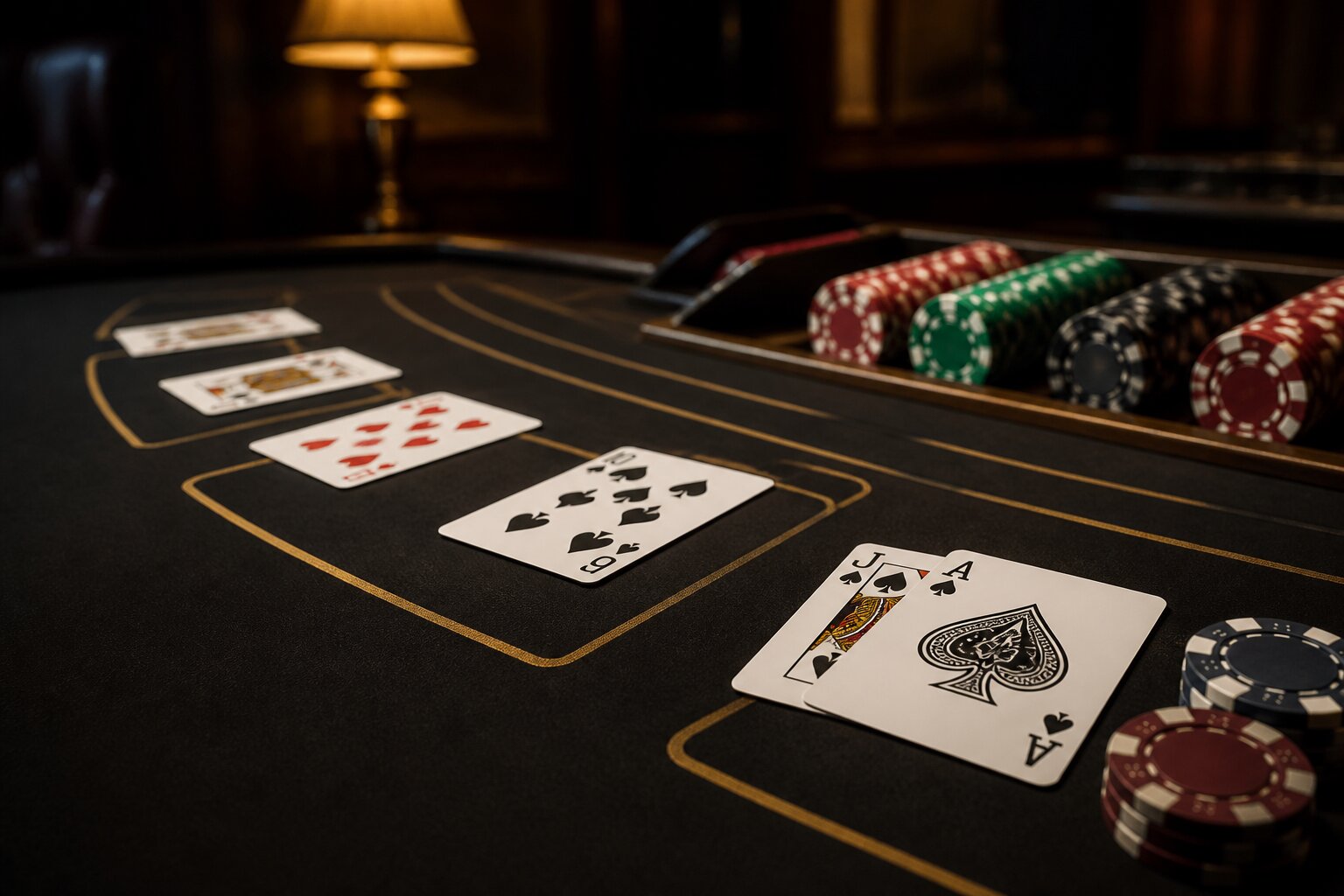
Whether you are just starting out or you have some experience, knowing which blackjack hands are strong and which are risky changes how you play each round. This guide explains the hands that give you the best edge, those that create difficult choices, and why the maths behind them matters.
Read on for a clear, practical ranking of hands, with examples and context that help you make better-informed decisions at the table.
What Are Blackjack Hand Rankings?
Blackjack hand rankings show which card totals are strongest in play, because the goal is to reach 21 without going over. Unlike games where suits or sequences matter, blackjack evaluates hands purely by their numeric total and whether an ace can be counted as 1 or 11.
A two-card total of 21 — an ace and a ten-value card — is the top result and is treated differently from regular totals. Other strong hands are simple high totals such as 20 or 19, which are hard for the dealer to beat in a single draw. Lower totals like 15 or 16 are precarious because the options to improve them carry a high risk of busting. Understanding these distinctions helps you decide whether to hit, stand, split, or double down depending on the situation. If you want to see which hands lead the rankings, the next section lays them out from best to less desirable.
Ranking the Best Blackjack Hands
Knowing the strongest hands lets you play with greater confidence. This section covers the hands that give the best return, followed by ones that offer useful flexibility rather than outright strength. Understanding the relative value of different hands helps you make clearer decisions at the table and reduces guesswork during play.
Natural Blackjack
A natural blackjack is the strongest opening hand: an ace plus any ten-value card, dealt as your first two cards. It is rare and usually pays more than a normal win, which is why it is prized. Because it cannot be beaten by any non-blackjack total, it often ends the round immediately, either as a win or a push if the dealer also has blackjack.
Many players view a natural as the most secure outcome because it minimises further action and settles the hand quickly. While the exact payout can vary by house rules, its value relative to regular wins makes it the most desirable two-card combination to receive.
Strong Two-Card Combinations
Two-card totals of 20 or 19 are next in strength. A 20, such as a pair of 10s or a 10 and a face card, is one of the most reliable hands and usually prompts a stand. A 19 is also strong and often worth standing on, especially against a dealer showing a weak upcard. These hands rarely need further action and provide clear, low-risk choices.
Because these totals are close to 21, they force the dealer to find an equally high or higher total to beat you, which is less likely. Standing on 19 or 20 simplifies the decision-making process and typically preserves your bet without exposing you to unnecessary risk of busting by taking another card.
Flexible Winning Hands
Hands that include an ace — known as soft hands — offer flexibility because the ace can be counted as 1 or 11. For example, a soft 18 (ace and 7) can be treated as 8 or 18 depending on what the dealer shows. That adaptability lets you pursue stronger totals without the immediate danger of busting, so decisions hinge more on the dealer’s visible card than on fear of going over 21. The strategic options this creates can be valuable in many situations.
Soft hands give you room to be more aggressive when appropriate, because hitting cannot immediately result in a bust. This flexibility can be advantageous against certain dealer upcards, enabling you to improve your total while retaining protection against losing by exceeding 21. Understanding when to exploit this versatility is a key part of effective play.
Identifying the Worst Blackjack Hands
Some hands create genuinely difficult decisions or narrow your options so much that results trend poorly over time. This section examines those hands and explains why they are problematic, and it highlights the practical implications for decision making at the table.
Problematic Starting Hands
A total of 16, particularly when facing a dealer showing a 10, is a classic trouble spot. For example, a 10 and a 6 or a 9 and a 7 forces a choice with no comfortable outcome: standing may lose to a higher dealer total, while hitting risks busting. That uncomfortable balance is what makes these starting hands so challenging; they frequently produce negative results in the long run.
The difficulty is magnified when the dealer shows a strong upcard because the dealer is more likely to make a hand that beats your 16. Conversely, when the dealer displays a weak card there is often a better case for standing, but the decision remains marginal. Over many hands, these marginal choices tend to erode returns, which is why 16 is widely regarded as one of the worst starting hands.
Hands with Bust Potential
Hard totals such as 15 or 16 are dangerous because many single-card draws will put you over 21. A hard 15, for instance 10 and 5, will bust if you draw a 7 or higher, and a hard 16 busts on a 6 or higher. Those probabilities explain why these hands often end badly and why decisions with them demand careful consideration rather than impulsive play.
Players should be aware that the risk of busting is not the only factor. The dealer’s likelihood of improving to a winning total and the remaining composition of the deck also matter. Taken together, these elements make hard 15s and 16s stubbornly unprofitable unless handled with appropriate strategy tailored to the specific situation.
Difficult Hands to Play
Some hands are neither obviously strong nor hopeless, but they require nuanced play. Soft 17, meaning an ace and a 6, is one example. You can hit without immediate risk of bust because the ace can count as 1 or 11, yet the hand can leave you vulnerable if the dealer has a strong upcard.
Whether to hit or stand with a soft 17 depends on house rules and the dealer’s visible card, which makes these hands more about situational judgement than a fixed rule. In some rule sets the recommended play will differ, and small changes in the game format can shift the expected value of each move. Understanding the likely outcomes of different moves helps you make the best choice for each deal.
With a sense of which hands are favourable and which are risky, it helps to see how those differences actually shape decisions at the table. Recognising the hands that often lead to poor outcomes allows players to apply consistent, measured choices that limit loss over time.
How Do Blackjack Hands Affect Gameplay?
Your hand total determines which options make sense and how aggressive or cautious to be. Each decision — to hit, stand, split, or double down — flows from the interplay between your total and the dealer’s upcard.
For example, a pair of 8s (a 16) is often split because it creates two starting hands with better long-term potential than keeping a single 16. Conversely, an 18 made from a 10 and an 8 is usually a stand, particularly against a dealer’s weak upcard, because drawing risks damaging a strong position. Soft hands change the calculation: with a soft 17 you can hit and potentially improve safely since the ace can convert to 1 if necessary, letting you pursue higher totals without immediate risk of busting.
These choices are driven by the statistical likelihoods associated with each total and the dealer’s visible card. The more you understand how each hand behaves in common situations, the clearer your decisions become in play. The next section explains why those statistical differences exist and what they mean for your choices.
Why Are Certain Blackjack Hands Favourable or Risky?
The favourability of a hand comes down to probabilities and the structure of the game. Hands close to 21 are powerful because there are fewer ways for the dealer to beat them in one draw, while mid-range hard totals are risky because the probability of busting when hitting is high.
Naturals and high two-card totals are strong because they either cannot be beaten by non-blackjack totals or they leave the dealer with a narrow set of winning sequences. Hard hands near the middle of the range lose value because attempting to improve them often produces a bust. Soft hands are advantageous because they provide room to take another card without the same immediate penalty, allowing more aggressive—but calculated—play.
Knowing these underlying probabilities helps explain why certain moves are recommended in basic strategy and why some totals are worth protecting while others invite risk. With this theoretical background, common questions about hand rankings become easier to answer.
Frequently Asked Questions on Blackjack Hand Rankings
What is the best hand in blackjack?
The best hand is a natural blackjack: an ace and any 10-value card dealt as your first two cards. It beats all non-blackjack totals and commonly pays a higher rate than a standard win. In many games, a natural blackjack pays 3 to 2 or 6 to 4, though some tables use different payouts, so it is worth checking the rules before you play.
A natural cannot be improved by drawing further cards, and if both player and dealer have a blackjack the result is usually a push, meaning your stake is returned.
Can any hand guarantee a win?
No hand can guarantee a win. Even the strongest hands can result in a push if the dealer matches them, or lose if the dealer has a stronger total. Outcomes depend on the dealer’s cards, the specific rules of the table, and the decisions made during the round.
Because blackjack involves both chance and choice, using sound strategy reduces long-term losses but cannot eliminate variance or ensure a profit. Always play within limits you can afford to lose.
Are some hands always losers?
No hand is always a guaranteed loser, but certain totals, such as hard 16 or hard 15, lose more frequently than others. These hands tend to perform poorly over many rounds because the statistical odds of improvement without busting are low.
That said, context matters. The dealer's upcard and the game rules affect whether standing, hitting, or taking other options is the statistically preferable play. Understanding these probabilities helps you make better short-term decisions.
What does ‘soft’ and ‘hard’ hand mean?
A soft hand includes an ace valued as 11, like ace and 6, often called soft 17. A hard hand has no ace valued as 11, or the ace is counted as 1 to prevent exceeding 21. Soft hands generally allow safer hits because the ace can be reduced to a value of 1 if you draw a high card.
This flexibility makes soft totals less risky to hit, and it can change basic strategy choices compared with equivalent hard totals.
How should I decide what move to make?
Basic blackjack strategy provides statistically informed choices for most common scenarios and reduces guesswork. Learning the core strategy means your decisions align with the odds over the long run and can lower the house edge in many games.
In addition to strategy, set personal limits before playing and stick to them to manage risk. Responsible play includes knowing the rules, understanding the odds, and avoiding staking more than you can comfortably lose.
This overview shows which hands give you clear advantages, which require careful judgement, and why understanding the maths behind totals improves your decision-making at the table.
Enjoy Casino Games at Slots UK
We’d love for you to experience what our site has to offer, where everyone is welcome to enjoy a fun and engaging casino environment at their own pace. Feel free to explore and play in a way that suits you.
Getting started is really straightforward – just create your account, make a deposit and you’re ready to dive into the excitement. We hope to see you around soon!
**The information provided in this blog is intended for educational purposes and should not be construed as betting advice or a guarantee of success. Always gamble responsibly.