
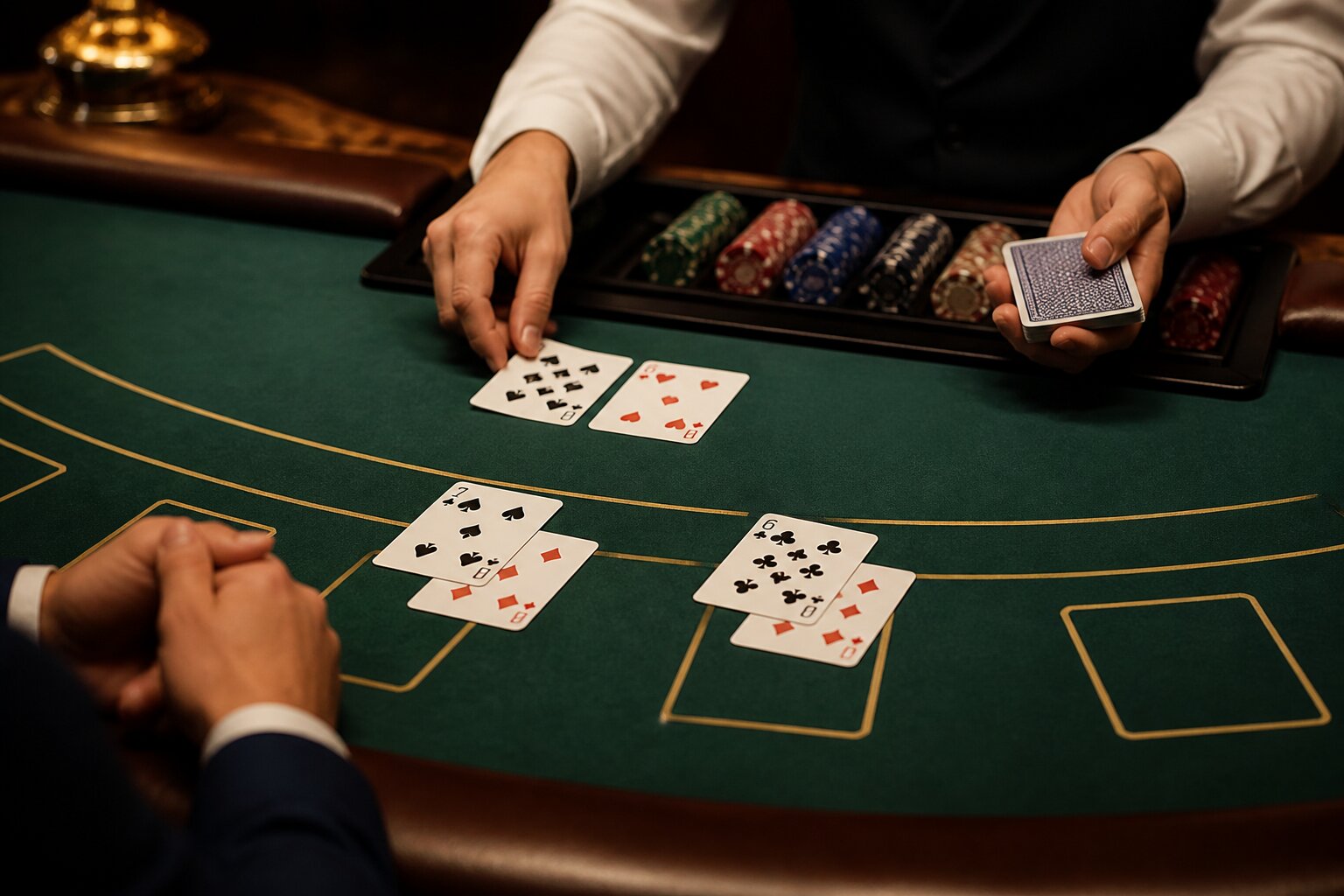
Ever wished you could swap cards between two hands in a game of blackjack and turn a losing situation into a winner? That’s exactly the twist Blackjack Switch offers. This variant lets players exchange cards between two hands, creating fresh strategic choices and new ways to approach the table.
It borrows the basic structure of classic blackjack but adds a single, decisive option after the deal that can reshape both hands at once. Read on to see how that choice works, what the dealer gets in return, and how the balance of risk and reward changes from familiar blackjack play.
What Makes Blackjack Switch Different from Classic Blackjack?
The defining feature of Blackjack Switch is the ability to swap the second card (the “top” card) between two player hands after the initial deal. Because you always play two hands and place equal bets on each, that single option can transform a weak pair of totals into two competitive hands.
Several rule changes offset this player advantage and are important to understand:
- You must place two equal bets and play two hands every round, rather than a single hand.
- The switch is limited to the second card in each hand and must occur immediately after the deal.
- A blackjack formed after a switch pays even money (1:1), not the traditional 3:2.
- If the dealer’s hand totals 22, that result is treated as a push against all non-blackjack player hands; those bets are returned rather than lost.
- Other house rules, such as how the dealer plays a soft 17 and whether doubling or splitting is permitted after a switch, are similar to standard blackjack but subject to table-specific variations.
- Most games use six or eight decks, which affects card distribution and strategy.
Together, these adjustments balance the power of switching so the game remains competitive. Next, we’ll walk through a typical round so you can see how those rules play out in practice.
Step-by-Step Gameplay Overview
A round begins with two equal bets, one for each hand. For example, placing £5 on each hand would commit £10 total.
Two hands are dealt to the player (two cards each, face-up) and the dealer receives two cards, normally one face-up and one face-down. Immediately after the deal you can choose to swap the second card from each of your hands. That single decision must be taken before any other action.
After switching (or leaving the cards as dealt), each hand is played separately. Usual options such as hitting, standing, doubling down or splitting apply, though table rules determine which actions are allowed after a switch. When all player hands are complete, the dealer reveals the hole card and plays according to house rules, commonly hitting on 16 or less and standing on soft 17.
Hands are then resolved against the dealer. Remember, if the dealer reaches a total of 22, that becomes a push for all non-blackjack player hands; switched blackjacks and natural blackjacks pay at even money. Keep a limit on how much you stake and stop if it no longer feels comfortable — playing within set boundaries keeps the game controlled and enjoyable.
With that practical flow in mind, the next section examines the specific rules you’ll encounter at most tables.
Understanding the Key Rules of Blackjack Switch
Players must place two equal bets and play two hands each round. The switch option applies only to the second card dealt to each hand and can be used just once, immediately after the deal. Once a hand has been acted on — for example, after taking a hit or splitting — no further switching is permitted.
Blackjacks pay at even money whether formed naturally or after a switch. A dealer total of 22 causes a push against all active player hands that are not blackjacks, so those bets are returned rather than lost. Dealers commonly hit on a soft 17, though some games may vary this rule.
Splitting pairs and doubling down are usually allowed after switching, subject to the table’s rules, and most games use six or eight decks. These points keep the game consistent with blackjack fundamentals while ensuring the switch mechanic does not become disproportionately advantageous.
Now that the rules are clear, we’ll look specifically at how switching operates in real situations.
How Does Switching Work?
Switching is the core decision in Blackjack Switch and it happens at one defined moment: right after the initial deal and before any further play. The swap involves the second card from each hand only. This restriction keeps the play simple and prevents later manipulation of hands.
For example, if Hand 1 is 9 and Q, and Hand 2 is 10 and A, swapping the Q and the A can produce two strong totals — 20 and 20 — from two otherwise uneven hands. That single move can convert risk into strength, or at least into more playable totals.
There are a few important limitations: the first card of each hand cannot be swapped, the switch must be done before any hitting, splitting or doubling, and a hand’s blackjack value after a switch is paid at even money. These constraints shape the choice you face and make it a strategic, not automatic, decision.
Next we’ll explain how payouts work and how these rule differences affect the overall house edge.
Payouts and House Edge in Blackjack Switch
Wins are paid at even money (1:1), including blackjacks created by a switch or dealt naturally. If the dealer finishes on 22, non-blackjack player hands push and the original bets are returned. When the dealer has a conventional winning total (less than 22 and higher than the player), losing bets pay as usual.
Because of the card-switching option and the 22-push rule, the house edge in Blackjack Switch is typically higher than in classic blackjack. Exact figures depend on the number of decks and table specifics, but house edges commonly fall in a range that reflects the added player choice. Understanding these payout rules helps set realistic expectations and informs which switching choices make sense during play.
To see how these elements come together, the following example walks through an entire hand.
Simple Example: How a Typical Hand Plays Out
Imagine placing two £5 bets. The deal produces:
Hand 1: 7♦, Q♣
Hand 2: 8♠, 7♠
Dealer: 9♣ (face-up)
Swapping the Q♣ and the 7♠ would yield 7♦/7♠ (14) and 8♠/Q♣ (18). You decide to switch, then hit on the 14 and receive a 6♦, taking that hand to 20 and then standing. You stand on the 18.
The dealer plays out and finishes on 17. Each player hand is compared to the dealer:
Hand 1: 20 beats 17, winning £5 at even money.
Hand 2: 18 beats 17, winning £5 at even money.
This illustrates how one switch can transform two mediocre hands into two winners. The same choice can sometimes produce mixed results, which is why switching remains an engaging strategic option rather than a guaranteed benefit.
Blackjack Switch rewards thoughtful decisions at the moment of the deal and offers a different kind of challenge from classic blackjack, finishing the topic with a clear picture of how the game changes familiar strategy.
Explore Casino Games at Slots UK
We offer a relaxed way to enjoy casino games, all in one welcoming place. Whether you are in the mood for entertainment or just keen to explore, you are always welcome to play with us.
Getting started could not be simpler: just set up your account, make a deposit and you are ready to enjoy our site. We look forward to welcoming you.
**The information provided in this blog is intended for educational purposes and should not be construed as betting advice or a guarantee of success. Always gamble responsibly.