
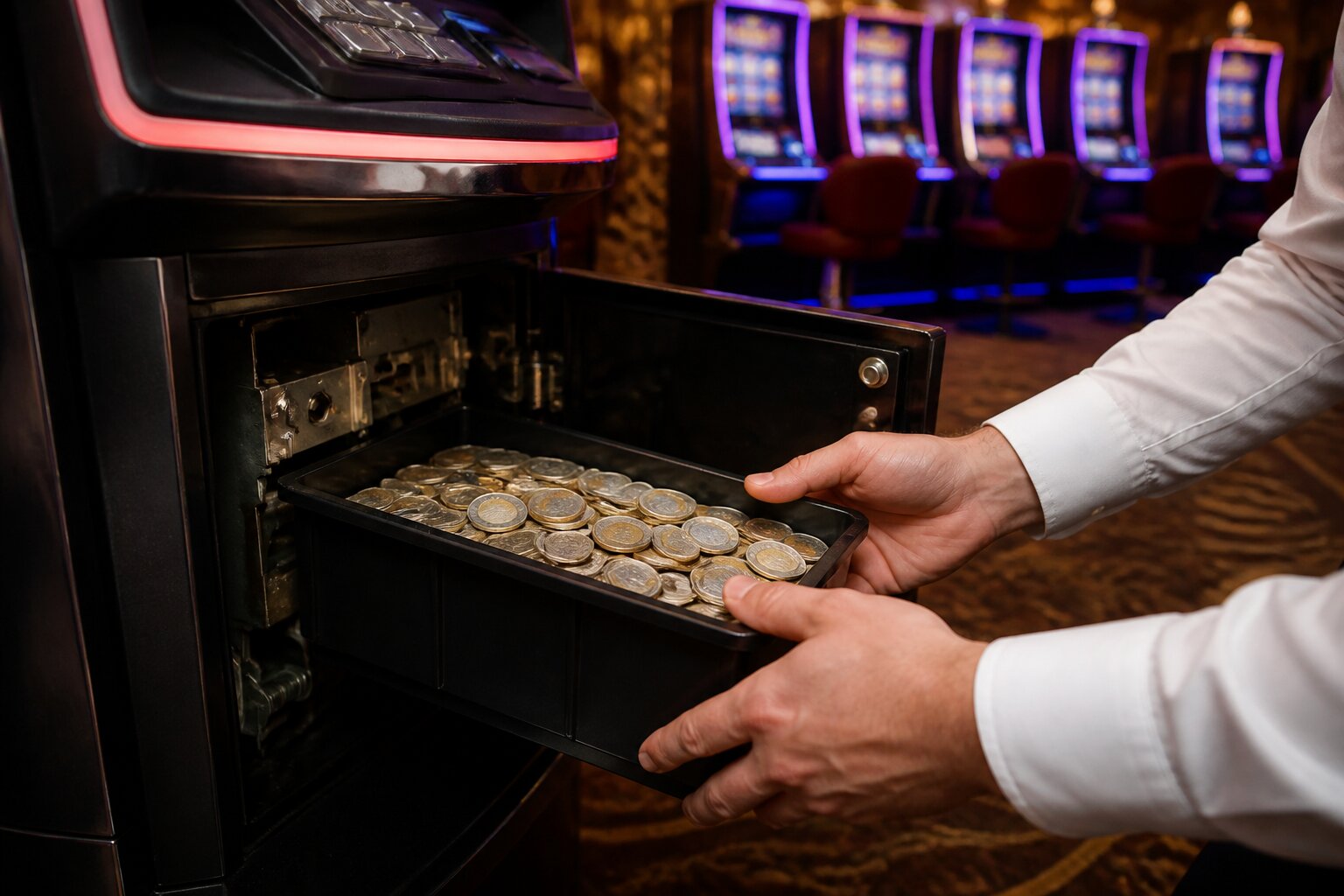
Ever wondered how much cash a slot machine can actually hold? It’s a question that comes up often from players and curious observers.
Whether you’re interested in the physical workings of casino slots or how online versions handle funds, the systems behind capacity and payouts are straightforward once you know what to look for.
Read on to learn how machines store money, what happens when they fill up, and how payouts and fairness are managed.
What Determines A Slot Machine’s Money Capacity?
A slot machine’s capacity is driven by its design and the regulatory framework that governs gambling operations. In land-based venues, machines contain a cashbox for notes and a hopper for coins; the physical size of these components sets the basic limit. Designers balance capacity against security and the practical need to empty machines at reasonable intervals.
Security features are integrated from the start. Lockable compartments, tamper-resistant fittings and surveillance ensure that stored cash is protected and only handled by authorised staff. In addition, operators follow procedures for transporting and accounting for removed funds.
For remote games, there is no physical storage: payments and balances are electronic and held within secure accounting systems. Those systems are subject to the same regulatory oversight as physical machines, so intended behaviour, auditability and transparency are all enforced.
These three factors—mechanical limits, security provisions and regulatory requirements—combine to define what a machine can legitimately hold and how operators must manage that capacity.
How Are Coins And Banknotes Stored Inside?
Slot technology has evolved from purely coin-operated devices to machines that accept notes and produce electronic credits. The method of storage depends on the model and its intended use.
Traditional machines use a metal hopper to collect coins. Inserted coins are routed into the hopper and, when a payout is due, the mechanism dispenses coins back to the player. Modern floor machines also include bill acceptors that validate banknotes and deposit them into a locked cashbox separate from the coin hopper.
Many venues have adopted ticket-in, ticket-out (TITO) systems. Instead of physical payouts, players receive printed tickets or digital vouchers that represent their credit balance. TITO reduces the need for large coin stores and speeds up transactions, while still requiring secure handling of the underlying accounting records.
Whichever system is used, the emphasis is on reliable validation, secure containment and traceable movement of funds. Machines are designed so staff can perform routine cash handling with minimal risk and full record-keeping.
Types Of Slot Machines: Coins vs. Cash-Handling Models
Older coin-operated models rely primarily on hoppers and mechanical sorting. These machines are straightforward in construction but demand frequent emptying and maintenance.
Cash-handling models include bill validators and ticket systems. They shift much of the stored value into sealed cashboxes or electronic records, reducing the physical bulk of money inside each cabinet. This change also alters how venues manage collections and audits, as more activity is routed through central accounting systems.
As you move between venues or different game types, the visible behaviour—coins dropping, tickets printing, or credits updating—reflects these underlying storage and handling choices.
What Happens When A Slot Machine Gets Full?
When a machine nears its storage limit, sensors and internal counters alert staff. These signals are part of the machine’s design, ensuring there’s no overflow and that payouts continue reliably.
Authorised technicians or attendants access the cashbox or hopper according to established procedures. Each removal is documented and often recorded on camera; the container is replaced with an empty unit and the funds are securely transferred to the counting room. These controls maintain a clear audit trail and reduce opportunities for error or misuse.
If a machine cannot complete a payout due to a technical fault, staff steps in to ensure the player’s entitlement is honoured, either by completing the payout from a backup source or taking the machine temporarily out of service until the issue is resolved. The priority is to preserve fair play and accurate accounting at all times.
How Do Casinos Monitor Slot Machine Payouts And Cash Levels?
Casinos connect individual machines to a central management system that records credits in and out, current balances, and operational alerts. This networked oversight allows staff to see which machines need servicing, which are performing unusually, and whether any irregularities require investigation.
Monitoring supports regulatory compliance: systems provide logs used in audits and investigations, and independent testing confirms that game behaviour matches published specifications. Regular reconciliation between machine records and physical cash movements forms part of standard financial control.
This technical infrastructure also enables swift responses to issues. If a machine reports a fault or an unexpected balance, operators can act promptly to protect customers and maintain accurate records.
Our site uses these same types of systems to ensure transparency and trustworthy operation, so players can rely on clear reporting about how games perform.
Typical Payout Percentages: What Should Players Expect?
Return to Player (RTP) percentages indicate the average amount a slot returns to players over a long period. Many games show RTP values in the low-to-mid 90s up to the high 90s. For example, a game with a 95% RTP would, over very large numbers of spins, return roughly 95p for every £1 staked.
RTP is a statistical measure and not a prediction for short sessions. Outcomes for individual players can vary widely in the short term, because machine results are independent from spin to spin. Games also present different volatility profiles: some offer smaller, more frequent wins, while others provide rarer, larger payouts. Knowing both RTP and volatility helps players choose games that match their preferences.
Operators must display or make RTP information available, and games undergo testing to verify these rates. Checking a game’s information page can give clarity about its expected behaviour before you play.
Myths About Slot Machine Jackpots And Payout Limits
There are several persistent misunderstandings around jackpots and limits. One is the idea that a machine becomes “due” to pay after a long dry spell. In reality, prior outcomes do not influence future ones; each spin operates independently under the game’s programmed mechanics.
Another myth suggests operators can change a machine’s maximum payout on a whim. Payout rules are set by the game’s configuration and the testing that certified it; operators can’t arbitrarily alter those terms without re-testing and re-certifying the game in line with regulations.
Some believe a machine might refuse to pay if its cashbox is low. Licensed venues are required to honour legitimate wins, and contingency procedures exist to handle payouts regardless of the machine’s immediate physical contents. These safeguards are part of the controls that underpin public trust in the system.
Understanding these facts helps separate speculation from how real-world operations and rules work.
Responsible Gambling: What To Know Before Playing
Slots are entertainment, and it’s important to keep play within personal limits. Before you take a seat, consider how much time and money you can allocate without affecting other commitments. Many platforms and venues provide tools to help manage play, such as deposit limits, session reminders and self-exclusion options.
Look out for signs that play is causing stress or interfering with daily life. If that happens, support organisations can offer confidential advice and practical help. In the UK, services such as BeGambleAware and GamCare provide information and can point to local support. If you prefer immediate help, the National Gambling Helpline is available on 0808 8020 133.
Using the available controls and seeking help early if concerns arise helps keep the experience safe and sustainable for everyone.
**The information provided in this blog is intended for educational purposes and should not be construed as betting advice or a guarantee of success. Always gamble responsibly.