
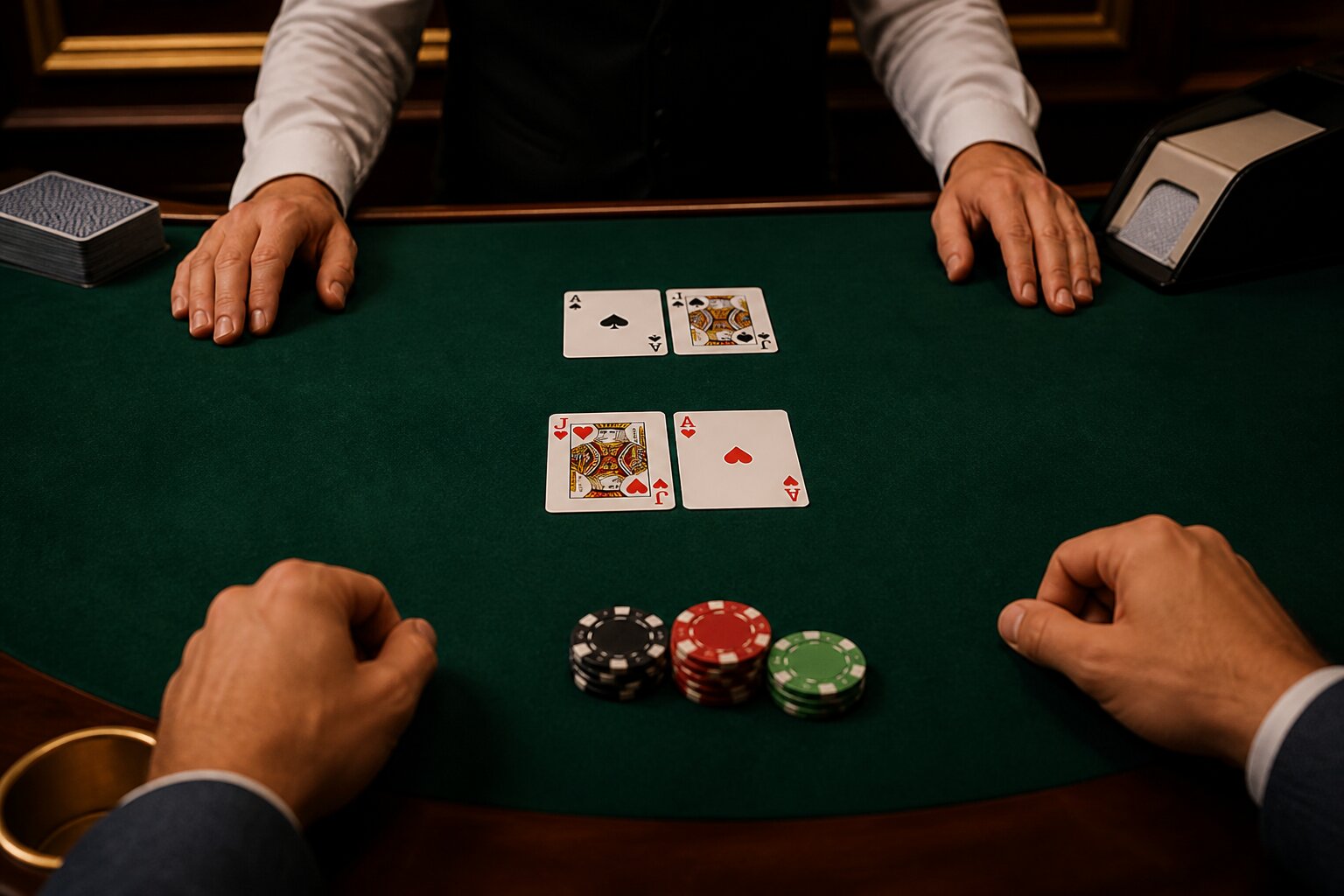
Blackjack is a fast-moving card game that centres on a simple goal: reach a hand value as close to 21 as possible without going over. That clarity makes those opening moments—when two cards are dealt to every participant—especially dramatic.
A blackjack is the strongest opening hand: an Ace plus any 10-value card. When both the player and the dealer are handed this combination at the same time, many questions follow about payout, side bets and what the rules actually say. The next section explains the basic mechanics so the outcome is easy to follow.
Understanding How Blackjack Is Played
Each round begins with two cards dealt to every player and the dealer. Players’ cards are usually face up; the dealer shows one card and keeps one face down until it’s time to reveal. Card values are simple: numbered cards match their number, face cards count as 10, and the Ace can count as 1 or 11 depending on which value suits the hand.
A blackjack is formed only by the initial two cards: an Ace combined with a 10-value card. That hand outranks any other 21 that is made with three or more cards. After the deal, players can exercise options such as hitting, standing, doubling or splitting where permitted, and the dealer follows fixed rules—typically drawing until reaching a predefined minimum, such as 17.
Knowing these basic mechanics makes it straightforward to understand what follows when both player and dealer hold a blackjack, which is exactly what we cover next.
What Is a Blackjack Tie or Push?
When the player and dealer finish with equal hand values, the result is called a push. In the specific case where both initial two-card hands are blackjacks, the round is a blackjack push: neither side wins the main wager and the stake is returned to the player.
This contrasts with situations where both hands total the same number using more than two cards; those also end as pushes, but they are not labelled blackjacks. The practical effect is the same in either case: the main bet is neither lost nor won. The following section looks at how that neutral outcome affects balances and separate bets.
Implications of a Tie for Players and the Dealer
A push leaves the main wager unchanged for both player and dealer: the round concludes without gain or loss on that stake. For players this means capital is preserved, so play can continue with the same funds; for the dealer there is no payout obligation on that hand.
Beyond the straightforward return of the stake, ties can influence a player’s session rhythm and decisions in subsequent hands. Knowing a push is possible helps set realistic expectations about outcomes during play, which matters when assessing strategy and bankroll management. The next subsection explains how payouts and additional bets are handled in these situations.
Payouts and Bet Returns
When a push occurs the original bet is returned in full. For example, a £10 stake is refunded as £10 rather than being paid out as winnings. No further sum is awarded for the main hand when both sides have blackjack.
Payouts for winning hands remain unchanged in other circumstances: a paid win will be settled according to the table rules, while a push simply restores the original stake. This keeps settlement clear and consistent for everyone involved.
Rules for Side Bets and Insurance
Side bets are handled independently of the main hand. If a player placed a side bet such as Perfect Pairs or 21+3, those are resolved according to their own rules and paytables regardless of a push on the main wager. A winning side bet still pays out even if the primary hand ends in a tie.
Insurance is a separate stake offered when the dealer’s visible card is an Ace. If insurance was taken and the dealer indeed has blackjack, the insurance bet typically pays at 2:1 while the main bet is returned because of the push. If the dealer does not have blackjack, the insurance stake is lost in the usual way.
With the settlement rules covered, the next section considers whether a push benefits the house in practice.
Does the House Always Win in a Blackjack Push?
A push is neutral: the house does not win the main bet, nor does the player collect a payout. In that narrow sense there is no profit for either side from that particular wager. However, since a push prevents a player win, it does reduce the number of winning outcomes the player would otherwise have in a session.
Over many hands the balance of wins, losses and pushes contributes to the casino’s long-term expected return, but any single push simply resets play without changing the player’s stake. With this settled, variations in rules and how games are run can still affect procedure and speed of settlement, which we explore next.
How Do Different Casino Rules Affect This Scenario?
Most blackjack rule sets treat a two-card blackjack versus a dealer two-card blackjack the same way: a push. Where differences arise is in dealer procedures, side-bet offerings and small rule variations that affect overall play rather than the outcome of a simultaneous blackjack.
Some venues check for dealer blackjack earlier, some allow different doubling or splitting options, and online platforms may automate results more quickly. These differences change the timing and available options in a round but not the basic result that two blackjacks equal a push. The following subsections outline typical contrasts without changing that central outcome.
Land-Based Casinos vs Online Casinos
In physical casinos dealers handle cards and chips manually, so the pace of settlement can be slower and there may be visible procedures for checking and returning stakes. Online games are automated: results are settled instantly and credits appear back in the player account without delay. Aside from speed and presentation, the rule about a blackjack push remains the same.
Popular Variations and Their Impact
Different named variants introduce rule tweaks that affect play but seldom alter how a two-card blackjack tie is treated:
- European Blackjack often delays the dealer receiving a second card until after players act, but a dealer and player both ending with a blackjack still results in a push.
- American-style games deal the dealer two cards up front; early blackjack checks can speed resolution, yet the tie outcome remains unchanged.
- Special formats such as those offering bonus payouts for certain hands may add separate prizes, but the main hand’s tie rule typically still returns the stake.
These rule differences influence how a hand feels and how quickly it is resolved, leading into the final practical point about whether a player can change the result.
Can You Influence the Outcome in This Situation?
When both the player and the dealer have a blackjack from the initial deal, the outcome is fixed: the main bet is returned as a push. No decision or strategy after the deal can alter that result because it is determined by the initial cards and the house rules governing settlement.
What a player can control is how they manage bets and which rule sets they choose to play under. Factors such as table limits, allowable doubles and splits, and the presence of side bets will influence longer-term results, but a simultaneous two-card blackjack is resolved the same way regardless of subsequent choices. A measured approach to staking and knowing the table rules ahead of play supports clearer expectations. In that spirit, remember that following responsible-play guidelines helps keep sessions predictable and within personal limits.
A push following concurrent blackjacks simply restores the original stake and the game continues; with the rules understood, the next hand begins and play proceeds as usual.
Play Casino Games Online at Slots UK
Settle in and enjoy the relaxed atmosphere of playing casino games with us at Slots UK. Our site is a welcoming place to unwind and have fun at your own pace.
It’s really straightforward to join us—just create your account, add funds, and you’ll be ready to explore our games. We look forward to welcoming you!
**The information provided in this blog is intended for educational purposes and should not be construed as betting advice or a guarantee of success. Always gamble responsibly.