
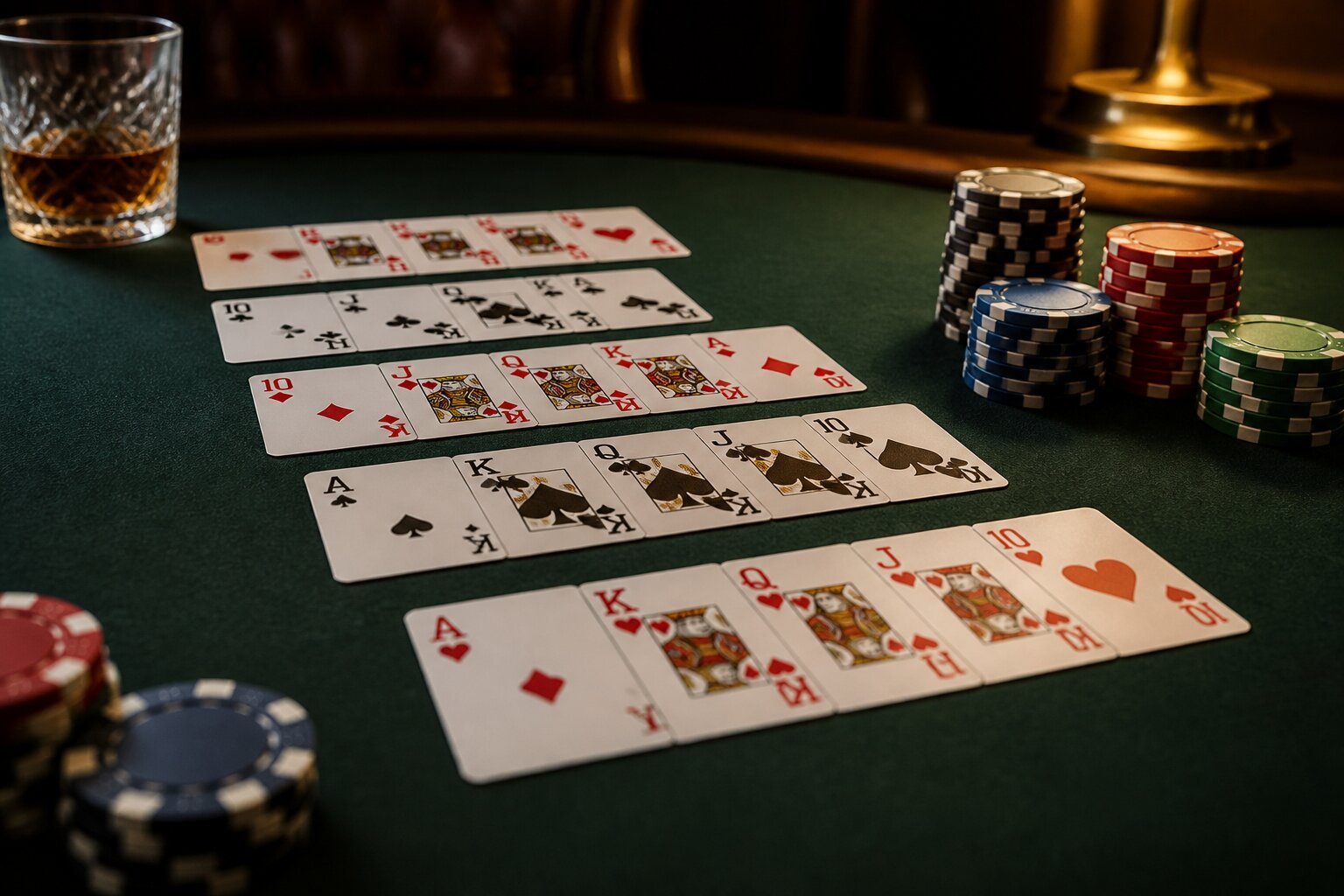
Ever found yourself staring at a pile of hole cards, quietly wondering if your hand is a winner or a washout? Whether you’re enjoying a relaxed evening at the local club or having a cheeky game with friends, knowing exactly where your poker hand stands is the key to feeling confident at the table.
The world of poker hands is full of unusual names — royal flush, full house, two pair — and they determine who wins each pot. Mixing them up can see a strong hand folded or a weak one overplayed.
Understanding the pecking order is straightforward once you see clear examples, and that clarity can change how you read the table. Read on to learn the ranking order, compare sample hands, and spot the common mistakes players make.
What Are Poker Hands?
A poker hand is the group of cards a player holds for the purposes of the round. In most classic games this is five cards drawn from a standard 52-card deck, though variants may alter how hands are formed.
Hand value rests on combinations: some are very rare and powerful, others common and low. These combinations exist so players can compare hands and decide a winner in a fair, standard way.
A simple example is 4♠, 5♥, 6♣, 7♠, 8♣ — five cards in sequence, which is called a straight. The next section lists the full ranking from strongest to weakest and gives clear examples for each.
Understanding the Poker Hand Rankings
Hands are ranked by how difficult they are to make with one deck. Below they are listed from strongest to weakest, each followed by a concise example to show the pattern.
Royal Flush
The highest possible hand: A K Q J 10 of the same suit. This is a special kind of straight flush and is unbeatable when it occurs, because it uses the five highest cards in a single suit.
Example: 10♠ J♠ Q♠ K♠ A♠
Straight Flush
Five cards in sequence, all the same suit. A straight flush ranks below a royal flush but above four of a kind. When two players have straight flushes the one with the highest top card wins.
Example: 3♥ 4♥ 5♥ 6♥ 7♥
Four of a Kind
Four cards of the same rank plus any fifth card. Also called quads, these hands are very strong; if two players both have four of a kind the higher rank wins, and if ranks are the same the side card or kicker decides.
Example: 8♣ 8♠ 8♦ 8♥ 2♣
Full House
Three cards of one rank and two of another. Known as a full boat, this hand beats a flush but loses to four of a kind. When comparing full houses the rank of the three of a kind determines the winner, then the pair if needed.
Example: K♦ K♠ K♥ 4♠ 4♦
Flush
Five cards of the same suit that are not in sequence. If multiple players have flushes the hand with the highest card wins, and if needed the next highest cards are compared as kickers.
Example: 2♠ 5♠ 9♠ J♠ Q♠
Straight
Five consecutive ranks, suits can differ. The ace can be high or low to complete a straight, but cannot wrap around, so A 2 3 4 5 is valid and so is 10 J Q K A. When straights tie the highest card determines the winner.
Example: 5♣ 6♦ 7♠ 8♠ 9♥
Three of a Kind
Three cards of the same rank plus two unrelated side cards. Also called trips or a set depending on how it was made, this hand loses to straights and higher hands but beats two pair. Kickers matter when comparing two three of a kinds of the same rank.
Example: 6♥ 6♣ 6♠ Q♦ 3♠
Two Pair
Two cards of one rank and two cards of another, plus a fifth card. When two players both have two pair the higher pair is compared first, then the second pair, and finally the kicker if required.
Example: 9♦ 9♣ 5♠ 5♥ J♣
One Pair
Two cards of the same rank and three unrelated cards. This is a common winning hand in many games; when pairs are equal the highest side cards or kickers are used to decide the winner.
Example: 7♥ 7♠ 2♦ 4♣ Q♠
High Card
No other combination; the highest single card determines the hand’s value. High card hands are compared by the top card, then the next highest, and so on until a difference is found.
Example: A♠ J♣ 8♦ 6♠ 3♥
Knowing the rank order makes it easy to see how different hands compare. Next, a short, practical example shows how those rankings settle a real showdown.
Please play responsibly. Gambling is for adults only; you must be 18 or over to participate.
Simple Example: How Poker Hands Are Compared
Imagine two players show their five cards at showdown.
Player 1: 9♣ 9♦ 9♠ 7♠ 7♥ — this is a full house (three nines and two sevens).
Player 2: 3♥ 4♥ 5♠ 6♦ 7♣ — this is a straight (five cards in sequence).
To decide the winner, the higher-ranking combination wins. A full house outranks a straight, so Player 1 takes the pot even though Player 2’s straight has a higher top card. When both players hold the same category — say, both have a pair — the ranks of those pairs are compared first, then any remaining cards (kickers) if needed.
That comparison principle underpins every showdown, and it’s useful to see how often simple oversights affect results; the next section points out common confusions to watch for.
Key Differences Between Similar Poker Hands
It helps to recognise the precise features that separate hands which look alike at a glance. Below are the main distinctions with short examples to make them stick.
Three of a kind versus Full House
Three of a kind is simply three cards of the same rank plus two unrelated side cards (5♠ 5♥ 5♦ 9♣ Q♠). A full house pairs those three with an additional pair (5♠ 5♥ 5♦ 9♣ 9♦), which is a much stronger hand.
Flush versus Straight
A flush consists of five cards of the same suit that are not in sequence (2♦ 5♦ 7♦ 9♦ J♦). A straight is five consecutive ranks where suits may differ (3♠ 4♦ 5♠ 6♥ 7♣). If the cards are both in sequence and the same suit, that becomes a straight flush, which outranks either category on its own.
Two Pair versus Three of a Kind
Two pair contains two cards of one rank and two of another (4♠ 4♣ 9♦ 9♠ 6♦). Three of a kind is three of the same rank with no additional pair (7♥ 7♣ 7♦ 4♠ K♣). Counting duplicates quickly shows which of the two you hold.
One Pair and Kickers
When both players share the same pair, kickers decide the outcome. For example, if both have 8♦ 8♣, the player holding the highest remaining card wins. Paying attention to kickers often settles close contests.
Being able to spot these differences at a glance reduces mistakes and helps shape the decisions you make during a hand. The next section highlights the types of errors players most often make and how to avoid them.
Common Mistakes When Identifying Poker Hands
Players frequently make a few predictable errors when reading hands. Here are the ones that cause the most trouble, explained clearly so they stick.
Confusing a Straight with a Flush
Seeing five cards of the same suit and assuming they form a straight is a common slip. If the cards are not in sequence, the correct classification is a flush.
Overlooking the Pair in a Full House
A full house needs a three-of-a-kind and a separate pair. Three of a kind alone, without that extra matched pair, is not sufficient.
Missing the Kicker’s Role
In pair-versus-pair situations, the highest unmatched card can decide the winner. Neglecting kickers leads to incorrect calls and misjudged bets.
Counting Mixed-Suit Sequences as a Straight Flush
A straight flush requires both sequence and a single suit. If suits differ, the hand is only a straight.
Undervaluing Three of a Kind
Some assume two pairs beat three of a kind; in reality, three of a kind ranks higher. Misreading the count of matching cards is the usual cause.
Careful verification of how many matching ranks there are, whether suits are uniform, and which side cards remain reduces these errors. With that foundation, it’s easier to move between different game types and know when the usual ranking order changes.
Popular Variants: Do Rankings Change?
Most familiar games such as Texas Hold’em and Omaha use the same ranking order described earlier, so the examples already given apply widely. However, several popular variants change the way hands are valued or introduce alternative objectives, so it’s important to learn the specific rules for the version you’re playing.
How Do Rankings Differ in Poker Variations?
Some variants alter the ranking order because the deck or hand goals differ. Short Deck Hold’em, for instance, removes certain low cards which changes the relative rarity of hands: in that format a flush can beat a full house. Lowball games invert the objective, favouring the lowest hand rather than the highest, so A-2-3-4-5 might be the best possible hand under Ace-to-Five rules. Razz also seeks the lowest hand, with straights and flushes typically ignored in the evaluation.
Knowing how rankings shift in these games helps avoid surprises at the table and keeps comparisons consistent with the format in play.
Are There Unique Hands in Certain Poker Games?
Some formats permit combinations that do not occur in standard five-card poker. Wild card games, where jokers or other cards act as substitutes, can produce five-of-a-kind — a category that outranks a royal flush. House rules or informal home variants may also introduce agreed special hands, but such variations should always be clarified before play begins so everyone uses the same standards.
Sticking to the applicable rules for the variant being played ensures every hand is judged correctly and that comparisons remain fair.
Playing with a clear grasp of the rankings, knowing how to read subtle differences, and being aware of variant rules will make your decisions at the table steadier and more confident. Keep practising these comparisons and the next time you show your cards, you’ll know exactly where you stand.
Play Casino Games at Slots UK
We invite you to explore our wide range of casino games, where you can enjoy plenty of choice and different ways to play. Whether you prefer classics or modern favourites, there is something for everyone to discover with us.
Getting started is simple: just create an account, make a deposit and you are ready to take part in the fun. We look forward to welcoming you.
**The information provided in this blog is intended for educational purposes and should not be construed as betting advice or a guarantee of success. Always gamble responsibly.